There are a good number of vegan and vegetarian restaurants in the city, which is to be expected in a metropolitan area with international influences. We have made a google map of vegetarian-friendly restaurants in the city which you are welcome to use. We have not tried all of the restaurants listed, but it's handy when you are out and hungry and want to find a place close by. Of these, our favorites are Teresa Carles, Addis Abeba (Ethiopian), Veggie Garden, Sesamo, L'Hortet, Maoz, and Biocenter.
Of course a hungry vegan can also go to just about any Thai, Chinese, or Indian restaurant, but note that many Chinese places, though abundant, are not very authentic and may not carry tofu or Chinese greens. I'm sorry to say, compared to the California Bay Area, the international cuisine here has not been quite up to snuff. Catalunya is a bit like Italy in that they love their own food and are happy to eat it every day for every meal, and other cuisines tend to adapt their foods to suit Spanish tastes.
Awareness and understanding of veganism amongst the general population is not very high. For example, when our kids go to parties or to a friend's house, I will often provide food for them since sometimes people are hard-pressed to come up with vegan options on their own.
One cannot really just go to any old restaurant and expect to find enough food to make a meal. But here are some typical local dishes which are generally vegan:
Aside from the obvious: patatas fritas (french fries), salad, bread, olives, hummus, and guacamole, look for these treats:
pimientos de padron a la plancha
grilled padron peppers
fantastic!
pa amb tomaquet
pan con tomate
bread with tomato, olive oil, and salt
simple but delicious
Setas a la plancha
Grilled mushrooms with garlic and parsley
More common in the fall. Delicious!
Alcachofas al horno
Baked artichokes with salt, pepper, and olive oil
Bueníssimo!
Escalivada
Oven roasted onions, sweet peppers, & eggplant
Swimming in olive oil
Patatas bravas
Oven fried potatoes with spicy tomato sauce and aioli.
Aioli is garlic mayonnaise, which sometimes contains egg, so ask.
Famous for a reason.
And if you are around in March, try the calçots, a type of onion, like a cross between a green onion and a leek in that it has flat leaves rather than round, and they bury the bottom to keep it pale and tender. The are roasted over an open fire until they are complete black on the outside and soft on the inside. At a Calçotada (a traditional onion roasting party), one peels off the outer layer and dips what looks like a banana slug into the special sauce (Salsa de Calçots, a type of Romesco made of tomato, garlic, almonds, olive oil, and spices) then savors the sweet flavor. Your hands get all black. It's lots of fun, and tastes amazing.
In addition fresh fruits of excellent quality are available everywhere. Most restaurants offer a menú (a menu of your choice consisting of an entree, a main course, drink, and dessert) which includes a postre (dessert) and they will have fresh fruit as an option.
OK, I knew I'd have to pay for my cockiness the last time I wrote about learning Spanish...
Let me just say that the honeymoon is over. Level 3 is a real step up from level 2. I am encountering lots of new vocabulary, and many of my classmates speak quite well, while I often feel tongue-tied.
It doesn't help that I arrive late to class twice a week because of my dance class schedule, and I leave early on Mondays in order to take Trevor to guitar class.
I seriously feel like I speak worse now than when I just arrived. Mark says that isn't true, and he thinks I am improving. But I feel more embarrassed now than just two months ago hearing myself butcher the language every time I open my mouth. I think at first I was just happy that people seemed to understand what I meant, and I didn't know how to speak grammatically, so I just said whatever came to mind and didn't worry about it. Now I know when I have used the wrong tense and I have to pause in the middle of my sentences to figure out how to form the verbs correctly, and I see the slightly strained look on the faces of the people I am talking to and get even more self-conscious. It's not good.
My brain is full! Suddenly words which I know that I know are harder to recall. Have I been drinking too much wine? Listening exercises have become more challenging. I cannot understand people with Andalusian or Caribbean accents. I get the general idea, but miss the subtleties because they are talking so damn fast. I hate that I can't understand jokes, and it's hard to make jokes.
Now that I know 4 different kinds of past tense, I not only have to figure out when to use them, but also how to form each verb in that tense, depending on whether it's first person singular, second person, third person, first person plural, second person plural, or third person plural! Should I use the preterito indefinido (distant, completed past) or the preterito perfecto (recent, continuing past) or the preterito imperfecto (describing the past), or the pluscuamperfecto (past tense of the past)? Telling one story often requires switching back and forth between all of these. Yikes!
In addition to the present tense, we have the future tense, the imperative, and the subjunctive, each with their own sets of irregularities. Adding to the complexity of verbal conjugation, once must consider, is the verb reflexive? Because the meaning changes a lot if you leave out one tiny pronoun. For example, cambiar means "to change," but cambiarse is "to change one's clothes". Quedar is "to meet with someone," but quedarse is "to stay in one place for awhile."
If I manage to get the verb right, I still have to worry about matching nouns, adjectives, and articles according to the number and gender of the object, which sounds easy at first glance, but there are enough exceptions to make it complicated. La mano and el poema are masculine, but el agua and la foto are feminine, while el paraguas and el microondas are both masculine and singular! Argh!!!
One of my least favorite things are pronouns, which vary depending on whether they are subject, direct object, or indirect object, male, female, singular, or plural. Do they go in front of the verb or behind it?
I also have a hard time with prepositions-- those tiny linking words which you just have to hear enough times to have a feel for what sounds natural. Should I use de or a or para or por or con? They all can mean "for/to/with/at." Finally, there are those pesky accent marks.
*sigh*
Can you tell I'm a little frustrated?
Sometimes it's not good to have high expectations of yourself, I guess.
I have about a month to review and prepare for my exams. Wish me luck.
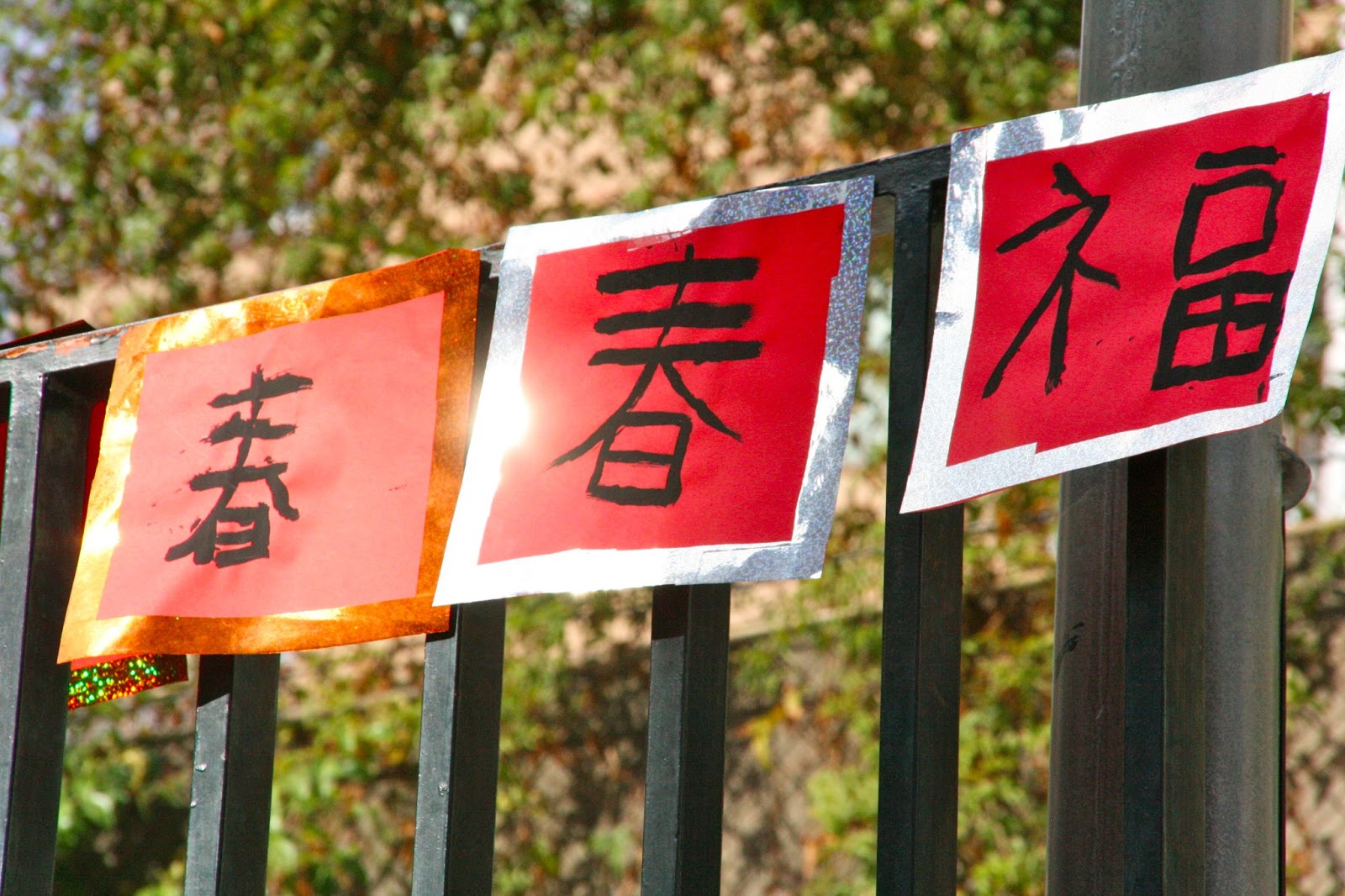
Every year the elementary students at Z & T's school have the option of spending three nights away from home skiing. The kids who do not go on the ski trip still attend school, but there is not much new instruction taking place at that time. Since our kids did not participate in the ski trip, and Chinese New Year this year happened to be during the exact same time, I asked the school whether they might be interested in spending the week learning about and celebrating Chinese New Year.
The school offers a once-a-week after school Mandarin class, there is one adopted Chinese student, and a few students from Chinese families, but these are a very small minority. In Barcelona there is a considerable and growing population of mainland Chinese immigrants, but they report that the New Year is not really celebrated here. Chinese families have large meals together, but that about sums it up.
Since I have coordinated Chinese New Year celebrations for many years at the various schools which my children have attended over the years, it was not terribly difficult. The school is not one in which parents volunteer in the classroom. The teachers are very professional, warm, and creative. I met once with the head of elementary instruction and the English teacher to suggest my ideas, they made a list of necessary items, and that was that. They handled everything! What a change from the public school we were at for the last few years, which involved a large corps of parent volunteers, and months of planning! Even the cafeteria got into the act and decided to prepare a Chinese lunch for the students.
I did invest some effort creating a powerpoint to help introduce the students to Chinese New Year.
Thankfully I was able to present in English. English is a regular subject in the school, and parents are very eager to have their children exposed to more English. It was a challenge for the students to understand all that I was saying, but they were so very curious and interested in the subject, it was marvelous to see. They have not had any exposure to Chinese culture really, so it was a real treat for them.
The teachers led various art projects, such as making paper lanterns, Chinese opera masks, dragon puppets, Spring paper cuts, writing Chinese calligraphy, learning about the Chinese Zodiac, and making ribbon sticks for dancing. The children even learned to sing the song Gong Xi, Gong Xi in Mandarin. They danced with their sticks at the same time.
They also learned to say two phrases, "Xin nian kuai le" and "Gong xi fa cai" in order to receive a red envelope with a chocolate euro coin in it from the headmaster.
video of kids enjoying themselves.
The older students created a 7 meter long dragon and paraded around the patio with it.
I felt very happy to be able to share a bit of my cultural knowledge with the students, who were very attentive and sweet. Their enthusiasm was so heartwarming. In addition, a lot of parents were very appreciative, and it was a nice way to "break the ice" and feel more a part of the school community.
Barcelona likes to dress up, and during the holidays the commercial streets all over the city are full of lights. Each street has a different design, and they can be quite elaborate.
The Catalan equivalent of "Happy Holidays" is Bones Festes (think Buenas Fiestas), which when written in script can look an awful lot like Bones Testes, which made Mark giggle more than once. Imagine gigantic lighted signs everywhere reminding you to think of your private parts.
An ice-skating rink was put up in Plaza Cataluña, so naturally we had to go. We had a great time skating with friends from school.
At school, the students put together a Christmas craft fair where they brought in items to sell to parents, with the money raised going to a local children's cancer hospital. Zoe and Trevor used glittery paper to fold origami cranes, and used them to make mobiles and even earrings. They were a big hit. The school also put together a precious DVD for parents with nicely edited videos of each class singing and dancing a different holiday tune, accompanied by teachers and students on guitar and piano. Some were in English, some in Spanish, and some in Catalan.
Barcelonans are crazy for their nativity scenes, which are called Belén (in Spanish, like Bethlehem) or pessebre (in Catalan). There is a large Christmas market, La Fira de Santa Llúcia, in the square outside the cathedral, where one can purchase boughs of fir and holly, Christmas berries, Tiós de Nadal, and a plethora of miniatures, ceramic and plastic. You'll find shepherds, angels, wise men on camels, Maria, Joseph, baby Jesus, mangers, animals of every kind, washerwomen, water wheels, windmills, barns, moss, and of course, the most iconic of Catalan figures, the caganer, or the guy with his pants around his ankles squatting in the corner dropping a deuce. He is often depicted as a Catalan peasant wearing a red stocking cap called a barretina and sometimes with a red and gold 4-striped Catalan scarf, but one can also find caganers of every flavor, including Santa Claus, footballer extraordinaire Lionel Messi, King Carlos, President Obama, etc. This beloved Catalan tradition of hiding a pooping figure in one's nativity scene dates back to the 1700s and is also practiced in parts of France, Italy, and Portugal. The Church apparently tolerates this irreverent figure. I like the down-to-earth sentiment that all humans must make poo, and thus we fertilize the earth and bring humility and realism to the holy scene. All of our relations received some version of a caganer as their holiday gift this year, so I hope they see the humor in it. :)
If you read Zoe's previous post, you already know about the Tio de Nadal, or the Christmas Uncle, which is a log dressed up in a hat and blanket, which poops out gifts. During the holidays every night the kids are supposed to feed the Uncle so that he has something to poop out. Then on Nochebuena, also known as Christmas Eve, they sit on it and hit it with a stick while they sing a special song. Then they lift up the blanket to reveal their gifts.
The song goes like this:
Poop, Christmas Uncle, almonds and nut brittle!
Because this night was born our Lord
Don't poop out a herring, because it's too salty
Poop out candy, because it's the best!
Poop, Christmas Uncle!
We had the privilege of sharing that special night with some wonderful Catalan friends. After a delicious feast, and after singing the song and hitting the pooping log uncle, Carles pulled out his guitar and we sang some Christmas songs. There are Spanish and Catalan versions to many of the standard Christmas Carols we know and love, such as "Jingle Bells", "Silent Night", and "The Little Drummer Boy." But we also enjoyed hearing some traditional Catalan Christmas songs, such as "Fum, Fum, Fum" and the beautiful "El Noi De La Mare (The Son of the Mother)." And of course we had to share "Mele Kalikimaka" (Merry Christmas in Hawaiian) with our new friends. I taught them how to dance to Pearly Shells, and they did great!
We spent two days at Port Aventura, which is a theme park about an hour south near Tarragona. Eight kids from Zoe's class and their families went together, and we all had a marvelous time. Zoe declared it, "The best weekend of my life!" I have to say the Shambala roller coaster, Europe's highest coaster, was absolutely fantastic. The ride was so smooth, not at all jerky, and it really felt like we were flying. (See the white one below)
Then we rented a car and drove to the Principality of Andorra, which is a teeny weenie country in the Pyrenees between France and Spain. There we skied for three days at Granvalira, which is one of the largest skiable terrains in Southern Europe. There was no new snow, but there was enough for us to have a great time, and we were really pleased with how the kids' technique is improving. They are now making parallel turns and starting to use their edges. Or course if the terrain gets too steep it all goes out the window, but that is psychological...
After all of that celebrating, we all got sick, and passed the germs around. Mark was unable to get out of bed for two days with a high fever, chills and sweats, so he missed New Year's Eve, which the kids and I celebrated at home making a 3D puzzle of the Sagrada Familia, reading "Harry Potter", and playing Carcassone, a great game that we got for Christmas. At the stroke of midnight, the custom in Spain is to eat 12 grapes, one with each church bell peale. Zoe hates grapes so she ate raisins instead. It is more difficult to do than it sounds, in part because they do not have seedless grapes here, so you have to peel them ahead of time and spit out the seeds while you stuff them in your mouth. Once I finally got the sickness, it took me three weeks to regain my energy level, and more than a month to evict the pathogens taking up residence in my sinuses.
Our lucky duckies got the best of both worlds this year-- they received gifts from the Christmas Uncle (Tió de Nadal) on the 24th, Santa Claus (Papa Noel) on the 25th, AND the Three Wise Men (Los Reyes Magos) on January 6th. Zoe was very excited to get her own MP3 player (my old iphone) and Trev loves his roller coaster marble run with battery-driven conveyor belt.
The big deal here is on the night of the 5th, when the Three Kings arrive by sailing ship at the port of Barcelona and are met by the mayor of the city. We braved the crowds to catch a glimpse of the bearded and long-haired Gaspar, the turbaned and swarthy Balthasar, and the wise old Melchior, accompanied by sizeable retinues decked out in glittering robes. There was an elaborate parade (of course, Barcelona loves parades!) and the streets were packed to the hilt with people being pelted by candies from dancers on elaborate floats. Like they do in New Orleans, you are supposed to eat a ring-shaped cake in which is hidden a toy. Whoever finds it is the king for the day, and buys the next year's cake. One puts their shoes outside that night, and on the morning of the 6th you find the presents that the Kings have left inside of your shoes.
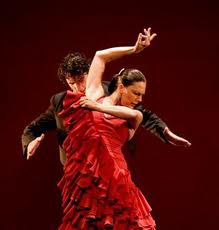
I always thought that Flamenco was a lot of bluster. You know, Gypsies acting proud and angry, clapping and stomping around the stage with lots of head tosses. Other than the fabulous ruffles, it seemed overly masculine to me. Well, there is a lot of clapping and stomping, and the posture is very straight and proud. But when we visited Andalucia (in southern Spain), the home of Flamenco, I learned that there is a lot more to it.
In Seville there is an excellent Museum of Flamenco Dance It is hard to find in the warren of narrow stone streets that meet at crazy angles and all look the same. Zoe and I got lost one night in the pouring rain trying to find it. That was fun. But the museum is very modern and informative, with lots of video displays, which is so important when you are talking about dance and music. I learned that there are many different rhythms and styles of dance (called Palos) within the umbrella of flamenco, including Bulerías, Alegrías, Tango (no, not the Argentine one. Completely different.), Soleás, Tarantas, Sevillanas and more. Some are slow and mournful, others fast and intense, some playful and happy. The museum also has performances and lessons. I highly recommend it if you are in Seville. It also explains the origins of Flamenco, which came from the Roma (Gypsy) people who originally came from India. Here is the wikipedia article on Flamenco.
The Roma have a long history of being poor migrant outcasts (and they still are stereotyped in Spain and Italy at least as people most likely to be begging or pickpocketing on the street). Their music, even when upbeat, has a touch of melancholy, like the Blues. Flamenco is tragic and (perhaps sometimes overly) dramatic and soulful. It must be danced with guitar and singer. There is improvisation. The dancing is usually done solo.
The rhythms are very complicated, with lots of syncopation. Many songs are based on twelve counts, but they are not evenly divided into three sets of four like the most western music. My teachers count to ten, and then to two, before beginning the cycle again.
and the accents are irregularly spaced, for example: 1 2 3 4 5 6 7 8 9 10 11 12.
I am not used to this, so I often kind of lose the beat and have a hard time knowing when to start. And often songs are fast-paced, which makes counting even harder. And the songs have llamadas, or standardized breaks in the songs, which have a different rhythmic patterns.
There is a lot of footwork, similar to tap dancing. Stomps (golpes), toes (plantas), heels (tacones), and complicated combinations of these performed at lightening speed. Instead of Tap's bouncy feel, Flamenco footwork is grounded in the earth. You POUND the floor, but your ankles and knees absorb all the impact so that your torso remains still, which means a lot of abdominal and glute control. Your feet should be kept very close together, almost touching. My shoes are low-heeled character shoes with nails pounded into the soles at the toes and heels.
In my class we drill simple step combos for almost half the class time, starting slowly and increasing tempo. It can be exhausting to concentrate on keeping a steady beat while holding our shoulders down, back straight, tummy tight, etc. My teacher, Laura, at the Jose de la Vega dance studio, is a drill sergeant. She has a stick that she pounds on the floor and she yells at us not the rush, to keep our feet together, to lift our heels higher, to keep our spines up to the sky, etc.
The arms are relatively simple, the key being that the elbows are always lifted up and pulled back for that classic Spanish line. One must lift one's chest up, but push shoulders and lats down, to create a long neck. We spend fifteen minutes just holding our arms out like Spanish scarecrows while rotating our wrists in the most exaggerated fashion, first circling towards the inside, then towards the outside. It makes my deltoids scream. I kind of like it. The pain. The suffering. It makes me feel powerful, like a bullfighter (without the killing).
I am reminded of the dance school in Cambodia which Mark and I visited, where the children were contorting their hands and feet in the most unnatural positions-- hands flexed with fingers curving backwards, feet flexed on legs lifted just so. Older students were correcting younger ones-- tilting their heads to just the right angle. It's amazing how training to perfect a particular aesthetic requires so much repetition and intense concentration. When I was a child taking ballet lessons, I never understood this, and I found the repetition and striving for perfection tiring and boring. Now I revel in it.
After an hour of very rigid technique, we have an hour of choreography where we have to put arms and feet and rhythm together with the music, and make it live and breathe. My teacher is wise to advise us to relax and dance from our bellies. It is here where we let our hips move and one can articulate through the ribcage so that we do not look overly uptight, and we let sensuality enter in. It's an interesting mix of graceful hands, strong and forceful arms and shoulders, undulating feminine hips and skirts, but controlled and powerful, slightly masculine footwork.
To be a soloist, one must have the utmost confidence, because all eyes are on you. I read that female flamenco dancers often peak in their 40s, when they have the maturity and the experience to really dance with passion and soul. Since I will be forty this year, I decided that this is the dance for me. I've done the sexy salsa thing and the graceful, happy hula thing. Now it's time to get tough. To get serious. To dig deep and dance from the gut. To embrace the sadness of life and summon the power and the passion within me. I am too old to be shy or embarrassed. I know who I am and how to use my body. That is what dancing flamenco is to me.
This is the one-hour intro to flamenco class that Zoe & I took in Sevilla in November 2011 at the Museum of Flamenco Dance.
This is a short choreography we learned at the end of my class. It's a Tango, which is one of the easier dances because it is in 4/4 time.
It's winter. It's colder and grayer and windier. I caught a cold which lasted for three solid weeks, and the snot and the cough are still lingering. After four months of being tough, adventurous, and positive, I'm going to let myself wallow in the negatives today. Here are a few things I don't like about Barcelona...
Business Hours
I hate the fact that most stores are closed on Sunday. Clothing shops, bookstores, sporting goods shops, fruit and vegetable stands-- even most supermarkets are closed on Sundays! Only the Pakistani mini-markets are open 24 hrs, 7 days a week. I was surprised to find that even the Chinese-run bazaars are closed on Sundays. Maybe my immigrant brethren tried opening on Sundays, but when no one showed up, they gave up and "did as the Romans..." Even during the prime Christmas shopping weekends in December, the department stores and entire shopping malls were closed on Sundays. If there is such a financial crisis going on, you'd think the businesses might try a little harder to sell their stuff!? It always seems like I wake up on Sunday mornings and realize that my refrigerator is empty...
During the week it doesn't get much better. The nearest supermarket doesn't open until 9:15am, and it closes by 9:15pm, Monday - Saturday. The majority of stores and small businesses close between 2pm-4:30pm every day, so if I don't shop and run my errands before lunch, it's all over. Banks and most government agencies close promptly at 2pm, and they are closed on weekends.
Only restaurants and bakeries are open on Sundays, because people can't live without fresh bread and a place on the sidewalk to lounge, smoke, talk, and eat. So what do most Barcelonans DO on Sundays? Apparently brunch is very popular. It's a time to visit relatives. But for us non-church-going, relative-less expats, who find it too cold in the winter to go outside, there is nothing to do except go to the movies or to a museum. When the weather gets better, I'm sure we'll be heading to the beach or biking or hiking or traveling and I won't be such a grump about it.
Even the nearest ski hill in Spain during peak season weekends is only open from 10a - 2pm. Four hours is considered a full day lift ticket?! I guess if you eat lunch from 2-4pm, then it's too late the ski after lunch, and you might as well quit at 2. And if you didn't eat dinner until 10pm the night before, you can't possibly be on the slopes before 10am the next day! It's all so logical.
Smokers Everywhere
Everyone smokes. It's impossible to walk one block without getting a lungful of cigarette smoke. Little old ladies, old men in berets, attractive young women, middle-aged men, moms and dads, taxi drivers, and most disconcertingly, the entire crowd of high-schoolers who blockade the sidewalk during lunchtime and turn it into a gas chamber. With everyone whining about the crisis and high unemployment, how are they all managing to watch 3,50 Euros (almost $5) per pack go up in smoke? Every pack is clearly emblazoned with SMOKING KILLS (FUMAR MATA) and other dire pronouncements. I am a little afraid that if we stay here too long, when Zoe gets to middle school she might succumb to peer pressure and start lighting up.
Thank goodness since January 2011 it has been against the law to smoke inside restaurants and clubs, and on public transportation. Still, it's allowed to smoke outside at the sidewalk cafe tables, so those areas are not as pleasant as they should be.
I am curious to know how much this addiction to tobacco is costing the Spanish government in health care costs, and why there does not seem to be much impetus to break the habit. It's not as if Spain is a big tobacco-growing country, so I am sure this addiction has a negative impact on Spain's trade balance. (At least in the case of China, which grows a ton of tobacco, I can understand the economic incentive to keep up demand for the product).
Dog Bombs
Living without a car in the city center means walking a lot, which is great. I am surrounded by amazing architecture, and I'd love to just look up at the blue sky and the ornate balconies, but alas, I walk with my head down, eyes fixed on the grey sidewalk, because I'm afraid I might step on a pile of dog poop! There are a lot of dog owners in this city, and despite the fact that there is a large and active army of street cleaners with brooms and power washers that work very hard every day to keep the place tidy, they are outnumbered by dog owners who do not pick up after their animals. I thought Paris streets were even worse in this regard. But after months of scanning the pavement, avoiding the patches of dirt that surround the little street trees, and observing the pee stains on the walls where the buildings meet the sidewalk, I'm just a little bit disgusted. I can't imagine NOT removing my shoes at the door of our apartment.
Websites
Coming from Silicon Valley, where every business that exists has a website, and online registration and payment is de riguer, this place is baffling. There are so many awfully designed websites! They are not clearly laid out, and they are very short on information. They basically just tell you to stop by or call during their limited working hours. The whole point of a website is to give information! To save time so their staff doesn't have to repeat themselves over and over. To explain who and what you are so people will know whether it's worth their while to find out more. What's even more galling, is that often the information posted on the website is inaccurate. When I show up to take a class, they tell me, "No, the website is wrong. Here is the paper schedule."
The Tyranny of the NIE
It is relatively easy for a citizen of country within the European Union to move here. They can easily get a NIE, which is a number kind of like a social security number and ID card in one. This 9 digit collection of letters and numbers is the key to happiness. Without it you cannot open a bank account (Unless you know the right person at the right bank to talk to. It took me a month of head-bashing to find a way). You cannot get internet service, or even a customer loyalty card at stores. You need that damn number for everything. And for Americans, it's very hard to get one.
I Miss Grass
They do not believe in grass here. There are no lawns. I'm sure this is much more water efficient, but it makes me sad. The parks are full of packed sand and pavement. There are trees and bushes, but very little grass. No sprinkler systems. School playgrounds are basically paved areas (patios) where kids play ball and tag. If they fall, they get scraped and bruised. No jungle gyms, swings, or playstructures here. The fancier private schools have soccer fields which are generally made of artificial turf. It is hard to find a place to go out on a Saturday morning to kick a soccer ball around except in the paved plaza.
Last minute planning
People here are great. But they don't tend to like to plan things ahead of time (other than birthday parties). I like to set a time and a place a week or two in advance, and then I show up. But that is not the culture here. It's more like, "Call me on Saturday morning and we'll figure it out then," or, "I'll see you at school and we can talk about it." Of course not everyone is like that, but in general, it's very different from the SF Bay Area where things are scheduled months in advance.
Minor Annoyances
1. How much is 10 degrees Celsius???
2. My recipes are in cups and teaspoons, but my measuring spoons and cups are in mg and ml.
3. Here, today is 30/01/2013
4. One and one-half is 1,5
5. One thousand five hundred is 1.500
I am enrolled in the Official Language School of Barcelona (Escola Oficial d'Idiomes Barcelona Drassanes or www.eoibd.cat) which is run by the Catalan Government (Generalitat de Catalunya). My friend Gina, who has lived here for 7 years and had taken classes at the school, recommended it to us. Mark is taking classes in Catalan two nights a week at the same school. The school offers very well-priced intensive courses in many different languages, and it can be hard to get a spot since it is quite popular. I guess we both got lucky. The registration process included online registration, standing in line for over an hour, taking a placement test, then showing up again to pay and register, again standing in line and not having a lot of choice. But I am happy to say that it was worth it, because I just completed my level 2 exams, and I feel like I have learned a ton in the past four months. My teacher was excellent, the textbook was good, and we did a variety of activities which encouraged us to practice speaking, reading, and writing. We didn't have much homework-- just enough, really. In addition to the almost daily immersion which is critical to language learning, I got to meet a nice assortment of people from around the world and make some good friends. My exams included a written test with listening and reading comprehension, and an oral test where we were paired up with another student and had to describe a photo and talk about it, relating it to our lives. The exams are pass/fail, and if one fails, you can repeat the same course. If you pass, you can register for the next level, and I think the process is much easier for continuing students. The facilites are nothing special-- a slightly run-down building in a slightly grungy part of town, but close to the main tourist area and completely adequate, with projectors in every classroom connected to a computer, and a big old-fashioned chalkboard. My classes were Monday-Thursday 9:30am -12pm right off La Rambla near where Mark works. So usually the four of us left the house together, we dropped the kids off at school, and continued walking downhill for 20 minutes to Mark's workplace, and then I would continue another 5 mins to my class. It was great to have a routine that got me out of the house daily. Also Mark and I could meet for lunch once a week. A lot of people here have commented that I can speak very well for only having lived here for four months. Comparing myself to my classmates, most of whom have already lived here for 2-3 years and still are having a hard time expressing themselves, I have to agree. I ROCK. And I owe it all to Mark. His Spanish is excellent by all accounts but his own. He studied it in middle and high school, he dated a Mexican-American in college, he worked in Argentina for a few months, and he did a research project in the Dominican Republic one summer. But really, he has a facility for languages and a passion for Spanish, so he has spent a lifetime listening to Spanish music, watching movies, and improving. I took two quarters of Spanish thru Stanford Continuing Studies back in 1996, which I really enjoyed, but it was once or twice a week. Ok, I got an A+, so obviously I have a decent ear for languages as well, but I didn't learn much more than a bunch of nouns and adjectives and some familiarity with the present tense. When we were expecting Zoë, we decided that from the get-go I would speak to her in my limited Mandarin, Mark would speak to her in Spanish, and the rest of the world would speak to her in English. It was a grand experiment. We even started in utero with a pair of speakers that we would place on my belly and sing and talk to her before she was born. Crazy overachiever parents. It is not easy to speak to your child in what is not your mother tongue. Mark and I learned a lot ourselves just trying to stay one step ahead of our kids. We learned children's songs in Mandarin and Spanish. We read books to them, and we attended music classes in Spanish with them. And I listened to him every day telling the kids to wash their hands and talking about clothing and whatever else people talk about in daily living. I rarely spoke a word of Spanish, but I could read kid's books just fine. In a way, I have been studying Spanish for the past ten years. So when I got here, I realized that I could understand a great deal (not TV shows because they speak really quickly, but at least 60% of conversations with people) but I couldn't form a grammatical sentence. I have a large vocabulary, but I did not remember the rules for conjugating verbs. In the last three months I have learned the simple past and the continuing past, as well as the present and future tenses. And with that, I am functional. I can go out alone and buy things, make bank deposits, go to the post office, and I have no fear of getting lost. Spanish feels really easy, in comparison to Mandarin. My pronunciation is pretty darn good if I say so myself, and now I have to work on increasing my vocabulary beyond the basic, commonly used verbs and add some more tenses, and I need to watch more movies and TV so I can train my ear. Zoe's Spanish has always been very good. She has a knack for languages and as often happens, parents are more strict with the first child than the second. Before Trevor was born, she always spoke to Mark in Spanish. But once Trevor became verbal, the two of them were all-English, all the time. In addition, Trevor was slower to speak any language, and he had some speech issues, so we let him speak English to us just so that he would express himself. He's kind of a quiet guy anyway. Before we came here he had no desire to speak Spanish, and I was certain that my Spanish was much better than his. I could recall a lot more words. BUT within one month of moving here, because he attends school from 9a-5pm immersed in Catalan and Spanish, and all of his friends here speak Spanish, now he corrects me all the time. "Mom, you said X when you meant Y;" or "You forgot the LO." It's AMAZING. We had him repeat second grade here, since he is already on the young side, and we weren't sure about the new languages, but in the first semester he got very high marks, and was even outperforming native Catalan speakers on some spelling tests, so starting in January he moved up to third grade and seems to be doing great. The first month we were here, before my classes started, I was already trying to think and talk in Spanish. Zoë was so embarrassed and annoyed by my butchering the language that she told me, "Mom, I would prefer if you would not speak to me in Spanish until AFTER you have taken classes." OUCH. For the first month or two, when picking up the kids from school, I didn't really know any of the other parents, and I felt shy about striking up conversations in Spanish. It was kind of hard. Luckily some wonderful parents were friendly to me and they are patient with me when I take a bit longer to express myself. And now I feel much more socially comfortable, although there still is a language barrier. Spending the day with some local families is wonderful and exhausting for me, as my brain is working overtime to keep up with the conversation for hours on end. But I feel great satisfaction that I am learning and growing even in my middle age. :) I have met some other Americans who have lived here for quite a few years already, but whose kids attend International School in English, or who work in an English environment, and thus have mostly expat friends, and they regret not having learned much Spanish at all. It certainly is possible to live in an expat bubble, since there is such a large community of expats here. I am glad that we did not choose to go that route, and we are integrating here. I actually think learning Spanish is helping Trevor and Zoe with their English vocabulary because so many of the Latin roots are similar, so many words which are higher level vocabulary in English have a commonly-used cognate in Spanish. The kids still prefer to read in English, but they will read Spanish graphic novels and magazines willingly. We haven't spoken or read in Mandarin for the last six months, since we got back from Taiwan. We were busy moving, and then we wanted to let the kids settle in with Catalan and Spanish. I was worried that they would forget the Mandarin which we have invested in for so many years. So we just started with once-a-week Mandarin tutoring for them, just to maintain what they have learned. Writing characters was the first thing to go. Yet I was pleasantly surprised that the kids did well in their first class, and even seemed to enjoy it. One benefit of living in a place where everyone is trilingual is that it just seems normal and expected. So different from the U.S.