Friday, April 10, 2015

Fer Pinya: Making Pinecone/Pineapple


In Catalan, pinya can mean either pinecone or pineapple, most likely because when the South-American fruit arrived in Spain from the New World,  it's spiky cone-shaped and fibonacci-patterned appearance reminded them of the Mediterranean pinecone.   To  fer pinya or "make pineapple/pinecone" means to work together; to rally in support; to gather in tightly like the radiating scales of a pinecone, each supporting one another.


See the resemblance?  

A common sight at festivals here in Catalunya are human towers or castells erected by castellers, groups of volunteers who train very hard to build amazing structures up to four stories high.  One of the best groups in the world are the Castellers of Vilafranca de Penedès, a small town outside of Barcelona. 


Here is a photo of their impressive human castles

My hubby is a HUGE fan on castells and so I figured there was no better way to celebrate his birthday than with a surprise castellers workshop with 30 of our closest friends.  I told him we would visit and learn the history of the colla (group).  What he didn't know was that we would also be building a castell of our own.  He was more than a little surprised.  

David Miret served as cap de colla or head of the group from 2007-2011.  
This person directs the building of the castells from the ground.

We learned that the tradition of building human castles originated near Tarragona in the 1700s but only within the last 50 years has it become popular and spread throughout Catalunya.  More info about castellers in general here, and more about the Castellers de Vilafranca de Penedès here.  

There are many ways to build a castell:  You could have levels composed of 1-5 people, stacked upon each other's shoulders.  The highest towers every successfully built are up to nine levels high! 


various types of structures

The child at the top is called the enxaneta or rider, and they raise their hand in the air with four fingers up, representing the four stripes on the catalan flag.  The person on whom the enxaneta sits is called the aixecador or riser. 

When I had viewed castells while standing in an overcrowded plaza during La Mercè, I was always too far away and too short to get a good view.  When you are lucky enough to get up close, you can really see the faces of the castellers as they bear ever more weight and risk injury literally climbing on the backs of their teammates with bare feet.  You can watch the tower sway slightly, see the grimaces and the trembling limbs as they struggle to maintain their balance.  Rarely have we witnessed a tower collapsing, but it is really dramatic.  The children who climb to the top wear helmets.  One's fall is broken by the heads and shoulders of the pinya below.   I often wondered whether I could deal with the smell of so many sweaty people all mashed together.  Luckily, it was not a hot day.  

A castell in mid-collapse


I was really happy to see that our frinds were eager to participate and the mood was really jolly and cooperative.  The majority of our friends in attendance were Catalans who had never participated in building a castell before.  That kind of surprised me, but after thinking about it, it made perfect sense.  Hawaii, for example, invented surfing, and it is known throughout the world, but not many people who live in Hawaii actually surf.  Both of these activities require guts, strength and balance.


First, we all put on the long cummerbunds or faixas which support the back and 
also serve as a place for climbers to put their feet.


 Next we learned how to brace each other in various formations.

Then we worked on standing on the shoulders of others. 
Notice the look of terror on his face.

The kids had much less trouble with this.

You really have to trust the people you're working with.

Just standing alone on one person's shoulder was scary. I can't imagine climbing five times higher!!!


Here we are making the pinecone.  
The raised hands will hold the legs and butts of the people above to help stabilize them.  

The people on the outer layers press inwards and buttress the pinya.

Our final challenge was to build a two by four castell, which means four levels in total including the enxaneta, aixecador, a torre or tower of two people, and the pinya.  I was to be part of the torre.  I climbed up on my niece's knee and up on my brother-in-law's shoulders, and finally stood a friend's shoulders.  I did not even notice the many hands supporting my butt and legs as the two women climbed onto our shoulders.  I did notice, however, the pressure on my left shoulder.  


We did it!!!

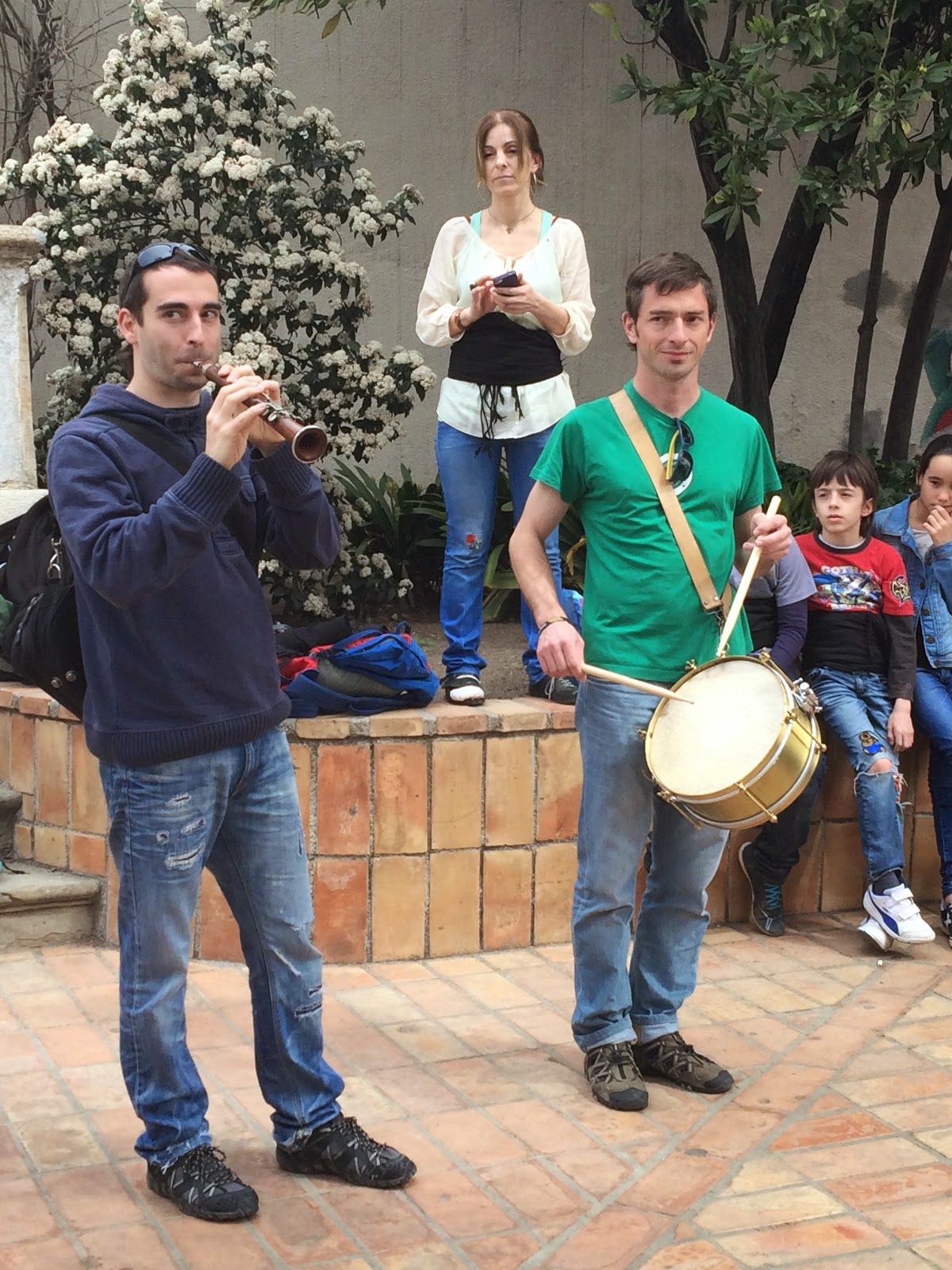
It would have destabilized me to look up and see what the two gals were doing up there, and doubtless for that reason castellers always are accompanied by a drummer and a gralla (like an oboe) player.  Specific tunes serve as signals for the ascent, the accomplishment of the castell, and the descent.  

The gralla and drum players


There is so much beauty in this activity: Firstly,  you take regular people with no particular physical skills, but by trusting each other and having courage, they are able to build something amazing. The contribution of each person is important to the endeavor, from the burliest guy to the tiniest kid. Secondly, it requires focus and dedication.  I was all smiles and laughs until the moment when the two women climbed onto my shoulders.  Then I put my game face on, and I did what in my flamenco class we call "touching the bottom," tocar fondo,  reaching into your reserves and drawing upon the strength you didn't know was there.  Building a castell is both an individual and a group challenge, and an adrenaline rush.  Often colla members spend years in the group, logging hours upon hours of practice, travel, and competitions.  The colla is a social and cultural organization and a symbol of community pride and unity.  All of these things make the experience so endearing to us-- a symbol of our three years here in Catalunya:  an experience of risk, trust, courage, friendship, hardship, solidarity, accomplishment and belonging.  


Our fantastic colla.


Monday, March 23, 2015

Managing Multilingualism


My mother speaks four languages: Fukinese (a Chinese dialect) which she spoke at home, Tagalog (Filipino) which she spoke growing up in Manila, Mandarin which she learned in K-12 Chinese school, and English which she learned a little in school but mostly upon arrival in the US at age 21. She speaks all four well enough to have fluent conversations and even business dealings in any of these languages, but I can only really judge her English, which is very lightly accented.  Only when she writes do her minor gramatical errors become evident.

My father speaks three tongues:  he grew up speaking Cantonese (another Chinese dialect) at home, learned Mandarin in school K-5, and English in school and upon arrival in the US at age 11.  He doesn't really read and write in Chinese anymore, but he can have fluent conversations in Mandarin and Cantonese.  His English has no real accent and he has an excellent vocabulary due to his high education level.  Despite having lived and worked in the US for the last 50 years, they both have maintained their multilingualism quite well.

I am a native English speaker.  I started studying Mandarin at age 10, and 30 years later I can manage to travel in China but can't read a newspaper or understand broadcast news.  Of course I have never lived immersed in Mandarin, so I haven't had the need to. Twelve years ago, when my daughter was born, my husband started speaking to her exclusively in Spanish, so I learned to understand a lot of nouns and phrases, mostly relating to diapers, food, hand-washing, animals, and the like.  I understood what he was saying to her, but understanding and speaking are two very different skills. Two years ago we arrived in Barcelona and I realized that I couldn't form a grammatical sentence in Spanish, so I enrolled myself in class and now I can survive and make friends.  It is discouraging to me how in such a short time I have been able to reach the same level of Spanish as it has taken me 30 years to achieve in Mandarin, but that is because English and Spanish have quite a lot of overlap while English and Mandarin have absolutely none.

I tried speaking exclusively Mandarin to our kids, and I did pretty well for the first three years with the first one.  My Mandarin improved a lot just trying to stay one step ahead of the children. However as the story always goes, my first child spoke only English to my second child, and after he showed some speech delays I switched to English with him as well, and it was all downhill from there.

We put the kids in Mandarin bilingual preschools and elementary schools, and spent a summer in Taiwan, and another in Yunnan to reinforce their Mandarin.  We hired Chinese or Spanish-speaking babysitters, attended Spanish and Mandarin music classes, and watched TV and movies almost exclusively in Spanish or Mandarin.  It wasn't too difficult in the San Francisco bay area where we lived, but it was a concerted effort which required time and resources.

Telling a joke in Mandarin
Singing in Mandarin

After ten years of formal Mandarin education, we decided to move to Spain to cement the Spanish foundation my husband had laid.  Mark, to his credit, was quite steadfast in his commitment to being Mr. Spanish.  For many years he spoke with a Latin-American accent which is favored in the US, but switched on a continental TH once we realized we were moving to Spain.  However, we chose to live in Barcelona, the capital of Catalunya, an autonomous community with it's own language, Catalan. Everyone here is bilingual at a minimum.

When they arrived at ages 8 and 10, the kids had literally never heard Catalan before, but within months they were reading and writing in it, and after two and a half years of immersion, they are conversing fluently and reading novels at grade level.  They attend a local private school which teaches in Catalan and Spanish, with English as a foreign language.  It's really incredible.  Thanks to their learning these languages early, they have good accents in all of them.  Because they are accustomed to being in a multilingual environment, they don't get tense or discouraged when they don't understand everything right away.  They just relax and pickup words here and there naturally.  I was surprised and proud that this year my daughter volunteered to be an announcer for the Carnaval show, which entailed memorizing numerous introductions in Catalan and performing them in front of the entire school, including parents.

singing in spanish
Presenting in Catalan


Now at 12, my daughter is just starting to surpass me in Mandarin vocabulary and comprehension. My son, on the other hand, has forgotten a lot in the last 2.5 years, but I don't blame him.  Mandarin seems useless here. Now that the kids have realized how easy romance languages are to learn compared to Mandarin, it is a little harder to motivate them.

In California, my son refused to speak Spanish.  Now he refuses to speak Mandarin.  I feel like I have spent the last 12 years doing a juggling act, doing my best to keep three linguistic balls in the air.   It can be rather tiring always trying to keep their language skills in balance, always reinforcing their literacy and fluency in something.  I am an educator by training and by nature.  When I noticed their English vocabularies were a little weak and they were not reading for pleasure independently, I started reading aloud with them to build their confidence and get them hooked on reading.  I'm absolutely convinced that reading for pleasure is the best way to improve spelling, vocabulary and grammar in a natural way, without realizing it.  I see now that since they never got hooked on reading independently in Mandarin, they will perhaps never reach a native level of vocabulary or literacy.  However, if someday they spend a year living in a Mandarin-speaking country, they will become fluent conversationalists.  I assign mommy homework and they hate it.  We have vocabulary words on the wall next to the dining table.  Movies are always viewed after reading the book.  I strive to keep Mandarin alive one hour per week.  I can tell that living here my own Mandarin has gone to pot, and even my English has suffered!  Sometimes I can only think of the Spanish word for something, and I have started spelling words which end in -tion with a -cion.  The truth is that in order to maintain literacy and fluency, you have to keep speaking, reading, and practicing constantly. Juggling is difficult to learn at first, but I hope once we reach a certain aptitude, it will get easier.

Right now our daughter's English sounds quite native, but our 10-year-old son speaks with some Spanish-isms which are kind of cute or funny.  Sometimes he turns Spanish words into English, like when he said, "I think he was just dissimulating (lying)." or "We wore winter hats in plain summer. (pleno = in the middle of)"  Other times uses Spanish grammar which speaking English.  For example, he often puts THAT (que) at the beginning of his utterances, "That you need to sign my test,"  which is not something a native English speaker would do.  His sentences make perfect sense in Spanish.  Example:  "It already passed 10 minutes? (10 minutes have already passed?)" or "They always put us a salad, (they always serve us salad)."  English remains the most important language for them to master, but we have faith that when we return to California for middle school, within a year or so their slightly imperfect English will be refined and polished.

I know they are proud of themselves, and they know that being quadrilingual is an asset.  The jury is still out over whether and how it may serve them in the future, but for my husband, a certified linguistic geek, and for myself, it has been a life-enriching challenge for us all.  We will keep on juggling.


Saturday, January 31, 2015

Seeing America Differently

I've always been very patriotic.  Corny as it may sound, as a kid, singing America the Beautiful in school assemblies sometimes made me teary-eyed.  I think it is because America is the country which granted my parents, through their ceaseless hard work and intelligence, the American Dream.  They came as penniless immigrants with minimal English skills and will retire successful and respected professionals and parents of children with advanced degrees.

And although I have at times felt ashamed of some of the actions of my country (CIA shenanigans) or hopeless about various issues that plague our society (ongoing racial discrimination), I've always considered the US of A the best country in the world, and my home sweet home.  Now, after two and a half years of living outside the country, I am for the first time feeling just a little less certain about the superiority of the EEUU, as they call it here.  Note that  I am speaking from my view as an educated upper-middle-class person who came from the Silicon Valley, one of the most competitive environments in the US, if not the world.  I just see the US from a different perspective now.

The economy here in Spain is not doing well.  Salaries in Mark's line of work are very low, less than half of what he would earn in the US.  There is more bureaucracy and regulation.  For example, a group of retail merchants on the most famous shopping street in the city recently petitioned the government to allow them to open for a few hours on Sundays.  It seems like a no-brainer to us, that with hordes of tourists looking to spend their money and an economic crisis in full swing, it ought to be up to the stores themselves to decide whether such a move would be profitable, but that's a very American perspective. Flexibility and efficiency is one of the best things about the US, I think.  On the other hand, protecting Sundays not for religious reasons but as a family day of rest and togetherness free from commercialism is rather beautiful.  Spaniards really do celebrate every cousin's birthday together, and have long family lunches every week.  I believe that type of strong family support is really healthy.

The fact that there is free, decent quality health care for all is really a tremendous relief.  Many people still opt for private health insurance, because it means no waiting times, and it is in fact quite affordable (for a family of four, less than $200 per month with minimal copays and no deductible!).  Most doctors work for both the public and private sector, and in fact the best doctors are in the the public hospitals, so if you have a serious concern, you go there.  Spain definitely wins in the health care department.

The work environment here is not particularly demanding.  People don't derive their identities from their work, and never talk about it outside the office.  It seems to just be something they do to pay the bills.  Things happen more slowly, and people are generally patient and understanding.  Apparently Spain has lower productivity than countries such as France and Germany, and that may be somewhat due to the long, fragmented work schedule, starting at 9, with numerous coffee and lunch breaks, but stretching to 5 or 8 at night.  This needs to change in order for the country to be competitive economically with the rest of Europe.

While we find people here well-educated and very competent, they are not necessarily striving for excellence or particularly dedicated to their work.  This complacency allows for inefficiency or mediocrity, and it can be annoying.  For example, when our wall became damaged by a minor water leak, I called my landlord.  She called the insurance company who manages the maintenance of the apartment.  They called me to set up an appointment for someone to look at it.  The guy came and filed a report.  Weeks later someone else came to look at it, but said he couldn't do anything.  So they sent another inspector.  Filed a report.  It's been two months, three people have come, but still nothing is fixed.  ???

The flip side of this is that when people are off work, they can generally disconnect.  There is time in the evening for socializing or relaxing.  The pace of life is slower.  There is time to stop and chat when you run into someone at the store.  Personally, I think this is very healthy.  In California I always felt like I was racing from one place to another.   I worry that when we return to the states the fast pace and competitiveness will come as a shock.  The quality of life here is definitely better. There is much less anxiety.   These people are not workaholics.  They put human relationships before money.

Our Bay Area friends have reported that applying for private middle schools is "a campaign" involving parent interviews, essays, letters of recommendation, standardized tests, student interviews, and more.  The pressure of SAT tests, APs, etc. seem to be driving Palo Alto teens to suicide, and it's really frightening.  Here, if you test well, you will get into a good public college that doesn't cost much.  There is much less competition.  Spain does not score high on world education rankings, but at least their kids are not self-destructing.  American competition these days seems overly cut-throat and inhumane.

Spain is not perfect.  There is racial discrimination against gypsies, muslims, and dark-skinned immigrants that needs to be addressed.  Unemployment is high and too many people are losing their homes.  Gender inequality is still pervasive, although there are many more female political leaders in Spain than in the US.  But gays can marry here, and there is virtually no gun violence because GUNS ARE ILLEGAL.  Imagine that!  Public transportation is really for all sectors of the public, not just the lower class.  All these things make me sad when I contemplate returning to California where traffic jams, mass shootings, stress-ed out students, overworked parents, and ridiculously high insurance premiums await me.


Monday, September 15, 2014

Choosing Foreignness

Last week the thought occurred to me, "I feel happy today.  Really and truly happy." It was a feeling of lightness, like a revelation.

It's not that I have been unhappy over the past 20 months of living in Barcelona, but it has been challenging in many ways.  I chose this challenge, and I thus I have faced it in my very rational way, constantly reminding myself of how lucky I am, eyes ever fixed on my daily to-do list.

It often happens with me that I don't realize how I feel about things until there is a change of state.  For example, I didn't realize how insecure I was as a child until I grew into self-assurance and could look back on myself with some perspective.  When I was a teacher, I knew I was working hard and that I struggled with certain aspects of the job, but I didn't realize how stressed I was until I stopped teaching. I think I am just the type of person who can tolerate emotional discomfort for long periods of time without realizing it.

That is probably a good thing, because becoming a foreigner in middle age is not a comfortable thing to do.  It's completely different from being a tourist and observing an unfamiliar culture from inside your protective bubble,  knowing that you will be home soon enough.  Becoming a foreigner is to choose to be an other;  an alien, a curiosity, a minority.  It carries a certain psychological burden.

If your home country is a powerful one, and you have money or status, then it's easier, because you are likely to feel welcomed and perhaps in some ways superior to the people or culture of your host country.  Although if the differential is too great, you may feel suspicious that people are being nice to you in order to get something from you, and that's not conducive to building real friendships and trust.  That is why we did not choose to move to an underdeveloped country.

If you come from a country which is more or less equally powerful as your host country, then there is a pleasant mutual respect.  The difference in culture is novel and interesting, and you can exchange recipes and ideas freely.  This is the situation we are in, and it's fantastic.  Many people want to learn English, and there have not been large differences in culture to navigate.

If your home country is a poor or troubled one, however, then the locals know you're vulnerable. You are here to work, and you have the burden on your shoulders of adjusting and integrating to the dominant culture.  They may look down on you,  or pity you.  Your customs, dress, and language may seem strange or backwards.  For example, I think about how it must be hard for muslim Pakistanis here: The women stand out like sore thumbs in their headscarves, and imagine trying to eat out when everything contains ham!  Those immigrants have every possible hurdle to jump:  language, culture, religion, and race.

The Spanish generally like Americans because they are familiar with our music and movies.  If they idolize America as a land of opportunity, they may ask, "Why have you come here?  Isn't life good where you came from?"  The locals know they have it good, with the Mediterranean beaches, the food, the weather, the social security... they wouldn't dream of uprooting themselves unless faced with the prospect of war.  They like the idea of visiting New York, Los Angeles, Las Vegas, and Hawaii, but they wouldn't necessarily want to live in what they think of as bible-thumping, gun-toting, crime-ridden, ultra-competitive America.

Of course people don't think I'm from America because of my face.  Often they assume I'm from Japan or China.  Unlike my husband, who can pass as a Spaniard on the street with his brown hair and eyes, I feel very conspicuous.  There is a growing community of Spanish Chinese, but the generation born here is still under 18.  I have no hope of looking local, so my foreignness can never be concealed, it's a part of my identity here.  It's not that I feel discriminated against here at all, but naturally they expect less of me here.

Growing up in Hawaii, I never had the feeling that I did not belong in America.  My America was a multiracial one, and living in northern California only strengthened that belief.  Although I have gotten used to being often the only Asian in the room here, I look forward to returning to California in part just to feel inconspicuous again.

I did not anticipate how so many inconsequential unknowns can add up to a low but constant level of stress.  Not knowing where to buy school supplies, how to get anywhere, where to get your hair cut, whether and how much to tip the stylist, or what company to use for internet service... all very minor concerns, but when added up make everyday living just a little more difficult.

It took me over a year to feel like I actually live here, to not feel like a tourist somehow.  It takes time to make real friends,  especially if there is a language barrier, so the first year I was surrounded by acquaintances.  I clung to any English-speakers I knew just to have someone to talk to, or any friendly Spanish people who showed an interest.  Over time real friendships have blossomed and deepened, and now I feel truly valued here.  Yet until I am really fluent in the language, I will continue to feel a bit disempowered, and not quite at home.  However, I do not regret this experience one bit.

Burkas in Munich

In Munich this summer we noticed a lot of women on the street in chador*, the generally black Muslim robes which cover everything but the hands, feet, and eyes.  (*Note that these terms are used differently in various countries)


Naturally I have seen photos of women wearing these before.  When I traveled to Malaysia I saw many women with hijabs* or scarves covering their heads, and the effect can be colorful and attractive.

But seeing the full-length jet-black chador on the street in the middle of a modern european city in summer had a strong impact on me.  The solid black color makes a stark visual statement, especially in contrast with the other people around in casual western dress.  Especially, as was often the case, if the woman in chador was accompanied by her husband and children, who were conspicuously NOT in traditional dress, but in normal western clothing.  "Why," I thought to myself, "have the men and children integrated into modern society while the women remain apart, isolated, stuck in the past? How must those young girls feel the day they can no longer run freely and must set themselves apart?"


I am not a religious person, but I am a liberal person who tries to be tolerant of differences of opinion and belief.  I try my best not to have prejudices, but like all humans, I come with the cultural baggage of being an American who lived through 9/11, Saddam Hussein, Osama bin Laden, and the Boston Marathon bombings.  In addition, as a feminist I found it very hard not to feel disturbed seeing these women enveloped in blackness.  It was very hard not to feel judgement.  Their children looked happy in their strollers,  on the playgrounds, and in the parks.  I wanted very much to see these families as similar to our own, yet I could not overcome my feelings of sadness.  I hope that the women wearing the chador feel that they freely chose to do so.  I hope they do not feel it a burden or a limitation.  But I can't help but feel that it MUST be one.  Bulky clothing does restrict a person's movements.  It makes it hard to play sports, to swim, and be active, which is one of the joys of my life.  Feeling the power of one's own body seems to me a human right.

A few times we noticed women wearing a kind of metal mask over their noses and mouths.  It looked a bit like a beak, and frankly it was a little frightening to look at.  I did a bit of research, and found that these are called burqa* and are common in the United Arab Emirates.


I'm sure they can be made to look beautiful, alluring, exotic, and mysterious.  However, I had a hard time not imagining that it might be hard to breathe or speak with something over my nose and mouth.

In this kind of burkha it must be hard to see clearly and I imagine it to be stifling in hot weather.

I can't help but think of footbinding, a despicable practice, now illegal and no longer done, in ancient China where girl's feet were broken and bound into tiny hoof-like shapes, to make them more desirable (and less mobile).  "Golden lily" feet were actually considered erotic.  Some cultural practices need to be discontinued simply because they are oppressive.

In the west, people only cover their faces in hospitals, during Halloween or Carnival, or when committing crimes.  I think it naturally triggers suspicion to see someone walking around with their face covered, as if they have something to hide.  It's a cultural bias, I recognize, but it does tend to make an unknown stranger seem less trustworthy.  I have heard some women who choose to cover themselves like the feeling of freedom from the sometimes preying eyes of men, that they don't feel like their bodies and appearances are constantly being judged as attractive or unattractive.  I think that argument is valid, although in the West they are likely to be judged for their religious belief instead.

It is terrible, but on a rainy day at the playground, a women in a black chador in the distance was gesticulating with her black umbrella, and for a brief moment it flashed through my husband's mind that she might have a weapon.  One can't deny that baggy robes would make it easy to hide things like weapons and bombs, and on the bus to the airport it again crossed my mind as I sat across from a woman in black.  "I hope she is not a suicide bomber.  I hope she is just a normal woman like me."

I am a bit ashamed to admit to having had these thoughts, and yet I think we should talk about these things, air our dirty laundry and let the sun shine on our humanity.  When I see a woman in a chador, this is what I see:


In April 2011 France passed a law which bans full-body coverings such as burqas and chadors, for security reasons as well as cultural integration.  Apparently they do not have such strong views on freedom of religion in that country.  I doubt that would fly in the US, but if we had a large influx of orthodox muslim immigrants to the country, I can imagine the conflicts that would cause.

I want for women everywhere to feel equally valuable, equally free to learn, to make, to do, to drive, to write, to read, to dream, to sing, to dance, to own, to earn, to travel alone, to choose their own spouse, to vote, to choose their own clothing, to have control over their own destinies.  Is that me imposing my western values on my muslim sisters, or is that what they also want for themselves?


Thursday, March 13, 2014

The Wong-VanHaren Parenting Manifesto

I will be the first to say we won the lottery in the genetics department when it comes to the temperaments of our kids.  But seeing how you can't ever really know how much is due to nature and how much to nurture, I think Mark and I can take a *little* credit for the wonderfulness of our kids, and after 11 years of parenting, reading countless books, attending talks, and sharing best practices with friends, I hope the general public will find this post interesting and perhaps even helpful.

I can't begin to express how thankful I am that Mark and I are mostly on the same page in regards to parenting styles and values.  There is such a wide range of beliefs out there, that if we had been on opposite sides of the spectrum, I'm not sure how we would have reconciled our differences.

I like that we discuss our disagreements in private, and generally present a united front to the kids.  We have seen families which have parents working at cross-purposes to each other, undermining each other's authority, and it does not go well.  So lesson number one is that both parents need to communicate calmly and come to agreement about things.

People regard our children as being very well-behaved, easygoing, adaptable, independent, adventurous,  and secure. I like to think that some of this is due to these guiding principles which have steered the course of our parenting.  Here they are:

1.  We, the parents, are in charge.

We believe that kids are born without the wisdom, experience, knowledge, and self-awareness necessary to make good decisions a lot of the time.  They don't realize when they are tired or even hungry.  They just want to play.  As they grow, we try to teach and empower them to monitor and understand themselves, and make more and better decisions.  When they have proved themselves capable of doing so, we give them ever-more freedom.  But basically, we are in charge, and what we say goes, because we know best and we want what is best for everyone.  If our kids disagree with something, they are welcome to discuss it with us calmly, but tantrums are never given into.  My tag line was, "Crying gets you nothing."  Sometimes I felt a bit mean to not give in when the kids were upset over something trivial, but I stuck stubbornly to my principles, and they learned quickly that there was no use in theatrics.  I waited tantrums out calmly, provide reasons, then restated the reality of what was going to happen, and eventually the kids accepted and complied.  If parents are firm but loving, and explain why they make the decisions they make, the kids understand and can deal.  We believe that learning to cope with not getting your way all the time is actually an invaluable life skill.  I can count on both hands to total number of tantrums these kids have ever thrown.

This particularly applies to both food and bedtimes, which are perhaps the two most difficult issues parents face with kids, and we think they are CRITICAL to a child's well-being.

FOOD:  We provide choices, but limited ones.  With toddlers, at most two choices.  "Today, you can have spinach and rice or beans and rice.  Which would you like?  Then you can have apple or tangerine."  The house is not a restaurant where one can order anything off the menu.  Dinner consists of the healthful, varied, adult meal that I have prepared.  Trevor can't stand mushrooms and Zoe hates asparagus, so we don't force them to eat these, and we make sure there are other options at the table that they will eat.  They can pick the offensive vegetable out of their stir-fry, for example, but must eat the rest.  If they have finished one bowl of that night's dinner and are still hungry, then they can look in the fridge for some other leftover they like better, or now that they are old enough to cook for themselves, they can make something like pasta with tomato sauce.   If they completely balked at the dinner and refused to eat any at all, our fallback was roasted cashew nuts.  These were acceptable to them, but not a treat.  Yet they were filling enough that we could let them go to bed having just eaten cashews, and not worry that they might starve.

DINNER is the meal we eat together without distractions.  No toys, books or electronics are allowed at the table.  We talk to each other about our days, plans for the future, and enjoy each other's company. Once in a blue moon we might have the TV on during dinner, but only under special circumstances, like the Olympics.

2.  Sleep is paramount.

All kinds of research shows the importance of sleep on attention, memory and learning.  We have observed many times that when the kids don't get enough sleep, their behavior deteriorates and they are less able to control their emotions.  We genuinely believe that one of the main reasons our kids excel in school and exhibit good behavior is not because they are smarter than the kids around them, but that almost everyone else is sleep-deprived.  Even at 9 years of age, Trev still needs 10 hours of sleep daily to function optimally.  If they can show us good behavior with less sleep, we adjust their bedtimes accordingly.  Our kids wake up on their own without alarms, which shows that they have gotten enough sleep.

They are also trained to respect the sleep needs of those around them, so if they wake up early and mom and dad are sleeping, they can read or play by themselves, or on weekends turn on the TV.  It takes years of training, but kids are capable of resisting the temptation to wake others up.

3.  Be independent.

We learned from Montessori preschool that even young kids can do things for themselves, and learn to take care of things.  Our cups, utensils, and plates are all in lower cabinets so the kids could set the table, put away  the clean dishes, and get themselves something to drink since they were 4 years old. Mom is not a waitress or a maid, and certainly not the trash can.  Whenever the kids try to hand me their food wrappers, I point to the nearest trash can and say, "There it is.  Or put it in your pocket until you find one." The rags, dustpan, and mini-sweeper are all accessible to them if and when they spill something.

4.  This is what to expect, and what I expect of you.

Whenever we are on our way somewhere, we set expectations and discuss how they might cope with any challenges that might be present.  We talk about who we are likely to see, remind them to greet people, remind ourselves of people's names. If it's a birthday party, we may talk about how there may be other friends of the birthday child they might not know, but they should be friendly to these children as well, and not be jealous if their friend goes off and plays with someone else. Since our kids are vegan, we talk about how there will likely be cake and pizza that they can't eat, but we have brought a treat for them that they can have, and we have snacks in case they are hungry.  We talk about how some kids might get overexcited and start cutting in line, but we aren't going to do that, we have to be patient and wait our turn. Before going to a theatre we talk about being a good audience.   By preparing our kids emotionally and mentally for various situations, although they may be experiencing things for the first time, they have already rehearsed things in their heads, and thus feel more confident and able to cope with challenges, rather than feeling overwhelmed or shocked by them. Likewise we talk about, "If we are separated while skiing, where is our meeting point?  If you are lost in the mall, what do you do?" Rather than scaring the kids, this empowers them and helps them to feel more secure.

As the kids get older, there are more serious topics to discuss, such as, "What if you are in a store with friends and they want you to shoplift something?" or "What if you are on the bus and someone touches you in a way which makes you uncomfortable?"  We cannot protect our kids from the evils of the world, but we can try to prepare them for how to deal with uncomfortable situations so that they will hopefully not be too shocked to react, or worse, feel ashamed and keep their problem a secret.

5.  Delay gratification and set priorities.

The cerebral cortex is the part of the brain which controls impulses.  Scientists say it doesn't fully mature until about 20 years of age, which is why adolescents tend to suffer from so many accidents. However, children as young as 3 can control their impulses, and in fact, like a muscle, the more those neural pathways are exercised, the stronger they become.  In the famous Stanford Marshmallow Study, preschoolers who were able to delay gratification for 15 minutes showed better life outcomes as adults. I believe that because our kids grew up vegan, and had to say no to all kinds of sweets that everyone else was partaking in time and time again, they have exercised self-restraint thousands of times, and thus have highly-developed impulse control.  I remember when Trev was 5 and he said, "Mom, can I...nevermind."  "What?" I asked, curious.  "Well, I was going to ask whether I could have a cookie, but I remembered that I already had one today, so that's enough."  I was completely astonished that he had internalized at such a young age the ideas of restraint and moderation that many adults struggle with.

6. Wong-VanHarens are tough.

Long before we had kids, Mark and I watched a biography of Debbie Allen and Felicia Rashad, two sisters who both achieved a great deal and project great self-confidence.  We were deeply impressed by the story they told about how their mother would make them look in the mirror and say to themselves, "I am bold.  I am strong.  I am beautiful."  We decided that we should do the same with our kids.  Give them a motto, a mantra, a strong identity.  We decided that Wong-VanHarens are tough.  We don't give up easily, we don't shy away from challenges, and we don't complain much.

Once in Hawaii we swam over to some lava rocks and went exploring with no shoes on.  The sharp rocks hurt my feet, but I wanted to see what was beyond, so I toughed it out.  Trevor was just 4 years old but I clearly remember him watching me limping over the rocks and saying, "Wong-VanHarens are tough, right Mama?"  Another day we were on a murderous hike to the top of the Ko'olaus, a steep 3000 foot climb up a narrow ridge.  After two hours, Zoe had had enough and called it quits.  Mark accompanied her back to the car.  I kept thinking that the top was just beyond the next rise, so I kept going, yet each time another rise appeared.  I was exhausted and about to give up when Trevor, at 5 years old, asked whether people could ever get higher than the clouds.  I said,  "If we get to the top, we will be higher than the clouds and you can see what it's like."  He agreed, and this spurred me on. After more than three hours of climbing we made it to the top.  The sea of clouds floated before us and obscured everything.  Then on a breeze the mist parted and we could see the entire windward side below us and out to the gorgeous blue ocean.  We were above the clouds.  I was so proud of that boy. We hiked for a total of 5 hours that day, and my knees were sore for a week afterwards, but he didn't complain one bit.  He's a Wong-VanHaren.

7.  Relax and don't be afraid.

As a girl who never played sports, I used to tense up whenever someone threw a ball at me, and I couldn't catch to save my life.  Finally I figured out that if I just relaxed and stopped telling myself I was going to drop the ball, I could catch just fine.  Fear and anxiety makes your body tense and clouds your mind, sometimes paralyzing you.  We try to teach the kids that one can do almost everything better when one is relaxed mentally and physically.

We enjoy outdoor activities which are somewhat risky, like scuba diving, mountain climbing, flyboarding, outdoor ropes courses, etc.  Many of these things require a person to confront their fears.  I was an extremely fearful child with overprotective parents, and it took me years to overcome my fears.  I did not want to teach my kids to be fearful or anxious, so I try to always model calm bravery and toughness.  We encourage them to climb things and learn their limits.  Of course we take safety precautions and don't take unnecessary risks, but I'm proud that they have virtually no fear of heights and are very confident in their bodies.


8.  Choose to be happy. 

We talk about how your life is a series of choices.  You can choose how to react (or overreact) to things.  You can choose to see a glass half-full or half-empty.  We try to be thankful for all we have, and just be happy with that.

9.  Use media for learning, and for entertainment, cautiously.

Mark and I both feel we wasted many hours of our childhood watching stupid TV shows.  Life is short, and there is so much to see and do.  We want our kids to actually play with friends when they are having a playdate, not just stare at screens in each other's presence.  We prefer that they interact socially or get some exercise outside.  In addition, we feel that advertisements and many shows carry stereotypic, racist, or chauvinist messages, like "pink is for girls" or "math is hard, let's go shopping" or "Asians are nerds".  They also often model negative behaviors, like fighting between siblings, talking back to parents, melodramatic eye-rolling, consumerism, etc.  Not to mention sexualization of children's characters (seriously, Monster High girls wear way too much makeup and too-high heels; have giant eyes, lips and boobs and tiny waists) and lots of violence.  While we aren't Luddites and want the kids to have basic knowledge of popular culture, we prefer to err on the side of overprotectiveness when it comes to media. Two very valuable resources are www.commonsensemedia.org and www.amightygirl.com. They both have detailed reviews and recommendations for books, movies, music, and video games which are appropriate for kids of various age levels.

We firmly believe that between ages 5-13 kids should be reading for pleasure as much as possible, building their vocabularies and imaginations.  Lots of excellent children's literature has been made into movies, and that is a great incentive for the kids to read the book first, and then watch them movie. Also our kids earn screen time by reading first.  And there are so many excellent educational apps out there, they can learn and have fun at the same time.  There are passcodes on all our devices because they really can be addictive.

10.  You can do just about anything, with practice.

Some things come easier to some people, but you can learn just about anything you set your mind to, if you practice it well and work hard at it, be it math, musical instruments, acrobatics, or what have you. So set goals for yourself, and make them a reality, one step at a time.  This is called a growth mindset, where you believe in effort rather than natural talent. People with this mindset are much more likely to be successful because they know if they put in the work, it will pay off.


Recommended Reading:  My all-time favorite parenting manuals.

1.  Healthy Sleep Habits, Happy Child by Dr. Marc Weissbluth.  About the importance of sleep.

2.  The No-Cry Sleep Solution by Elizabeth Pantley.  If you have a kid who doesn't fall asleep easily by themselves.

3.  How to Talk So Your Kids Will Listen, And Listen So Your Kids Will Talk by Adele Faber and Elaine Mazlish.  How to sound less like a nag, and show your kids you understand how they feel.  My favorite trick is just describing what exists rather than telling them what to do.  Example, instead of "Pick the clothes up off the floor!" try, "I see dirty underwear on the floor."

4.  The Kidpower Book by Irene Van der Zande.  Teaches physical and emotional safety.  How to avoid being bullied, how to set boundaries, and keep yourself safe.  Kidpower.org offers excellent workshops as well.

5.  What to Read When: The Books and Stories to Read with Your Child--and All the Best Times to Read Them 
by Pam Allyn.  Makes the case for reading, and recommends great literature for all ages and stages.  


My favorite educational iphone/ipad apps:  Please send any recommendations my way!

1.  DragonBox  teaches algebra in a sneaky fun game, age 8

2.  My Robot Friend teaches cardinal directions, addition and subtraction, positive and negative numbers, sequencing.  Age 5

3.  The Opposites  vocabulary building game, age 7

4.  SAT Vocab vocabulary building, age 10

5.  Marble Math  Math skills but fun.  Fractions, multiplication, division, age 7

6.  Brainpop short videos on scientific or historical subjects, aimed at kids.  Age 6

7.  Cargo-Bot puzzles requiring sequencing and teaching basic programming.  Age 7

8.  Tinkerbox  build your own virtual Rube Goldberg machines or puzzles using your understanding of physics and simple machines.  Age 6

9.  Scramble  boggle, age 6

10.  Stack the Countries  world geography, age 6


Sunday, March 2, 2014

Dancing: My life journey

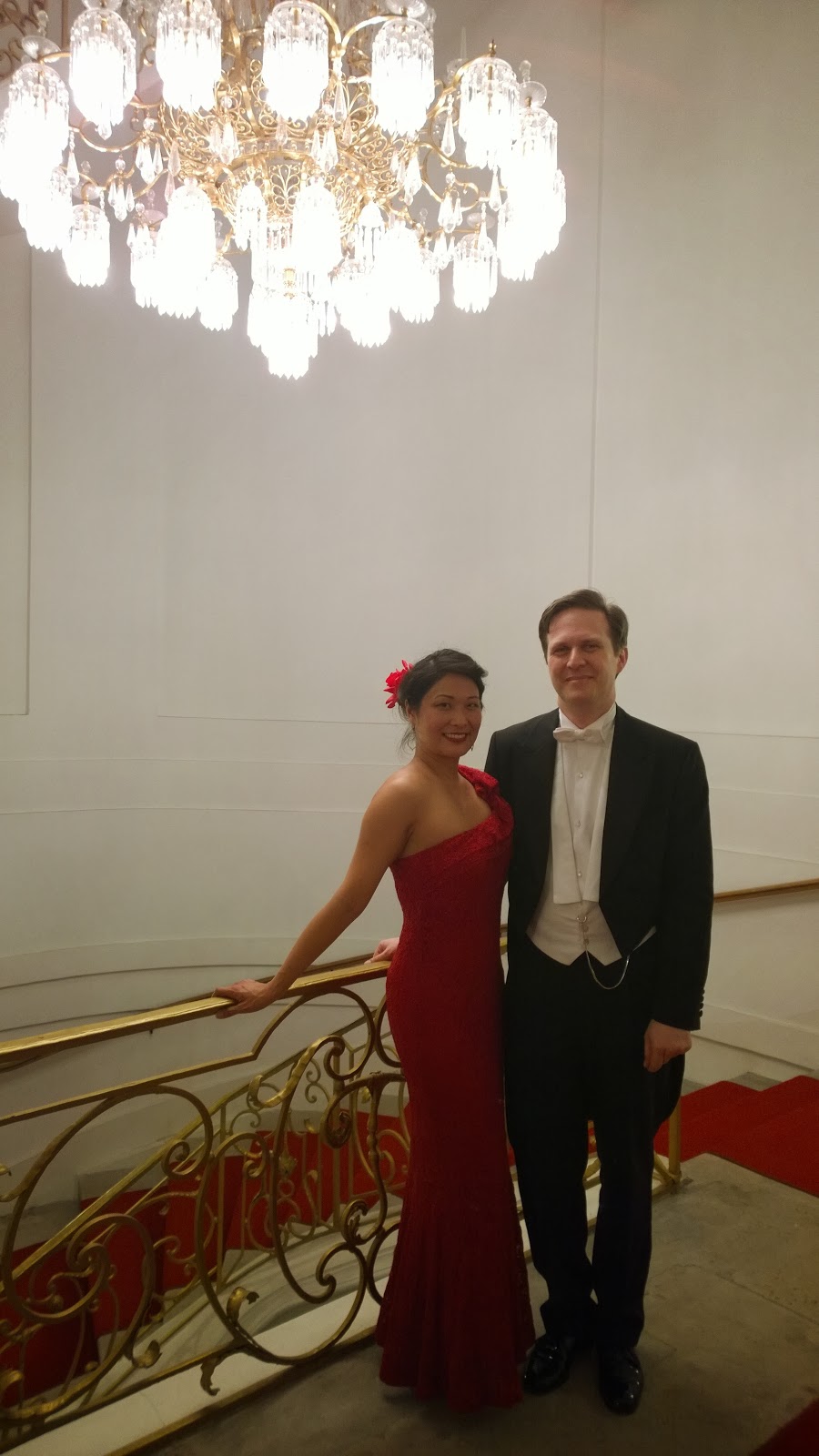
Last week I participated in a wonderful week-long ballroom dance holiday called Waltz Week in Vienna which culminated in the chance to attend two authentic Viennese balls.  As a Stanford undergraduate I attended the Viennese Ball put on by students there, but at the time I did not really know the history and tradition associated with balls in Vienna.  Hundreds of elegant balls are thrown in the city of Vienna during the fasching season between November and February.  The Viennese waltz is quite fast (180 beats per minute) and consists of continuous spins, and it was popularized during the 18th and 19th centuries thanks to the Strauss family of composers.  It is still customary for young people to take social dance lessons.  I can't describe how amazing an experience it is to attend a ball in the ridiculously beautiful Hofburg Imperial Palace  and dance to live bands and orchestras.  Attending the ball with a very seasoned dancer was a dream come true.  He navigated me safely through the crowded dance floor and when we waltzed it was like flying (in fact, he is a pilot).  Literally the room was spinning and I liked it that way!


I am pleased to have finally taken my social dancing to a new level.  I've been on a lifelong journey through many different styles of dance, and while I enjoy them all, I have to admit that there is something uniquely special about social dancing.  By social dancing I mean dancing with a partner without choreography, where there is a leader and a follower, regardless of the type of dance or music. I have reached nirvana in social dancing and I describe it thusly:  When both partners have attained a level of dancing in which they no longer need to think about the counts or the steps, and they can just interpret the music using their bodies, something magical happens.  


I think it's beautiful that two people who might be complete strangers, without speaking a word, through three points of contact can create an ephemeral work of art out of thin air.  We are pattern-matching beings, and when the movement through space matches the music we hear, it just feels right in the soul.  When the pauses, hesitations, or hits of the music are echoed in the kicks, poses, or leans of the dancers, you can't help but smile.  When as a follower you can trust your leader enough to flow with him, match him in mood and intensity, manipulating your weight and centrifugal force in just the right manner that you feel like one body gliding through time and space at velocity, changing directions without friction or loss of energy, it's just plain awesome.  Part of the beauty is that it's all novel and unexpected. With a good leader, you can do a step you've never seen before, and be pleasantly surprised.  The leader, while they have in mind what step they plan to lead next, must also be ready at any moment for a change of plans-- be it a missed hand connection, an obstacle on the dance floor, or a follower's embellishment.  I have nothing but admiration for skilled leaders, who are literally always thinking on their feet.  

On one hand dancing is complicated, but on the other I feel people get too tense and over-think dancing.  Dancing is just walking, with style.  It's fun-walking.  Just put yourself in the mood of the music and walk in rhythm with it.  If it's bouncy, you bounce.  If it's sensual and sexy, you move your hips and glide smoothly.  If it's elegant and graceful, you lean and sway with it.  Perhaps it feels natural to me because I have so many years of dance experience behind me. 

I grew up dancing ballet, jazz, tap, and hula thanks to my mom's great foresight and need for after-school childcare.  I wasn't particularly good at it at the time, but I enjoyed myself; increased my balance, coordination, and flexibility; was exposed to a wide variety of music; and learned to love performing, costumes, and moving to music.  The ability to spot my head when turning, to have graceful hands, and to pay attention to body lines I consider priceless skills that serve me to this day. However, dancing solo is completely different from partner dancing.

When I was in high school my parents started ballroom dancing with their Filipino friends.  They dragged me along and I learned the basics of rumba, cha-cha, waltz, and swing.  They had great fun learning choreographies and going on cruises with their buddies.  Although I found it kind of fun, it did not call to me. At the time ballroom dancing seemed slightly tacky; a world of fake tans, excessive makeup, overly expressive faces, and loads of sequins.  It was something old people did to bad elevator music.  The focus of instruction was way too much on the steps, and not enough on the connection and the art of partnering.   When one is dancing with not-very-skilled partners, be they overly jerky and painfully wrenching, or confusingly soft and indecisive, it is hard to feel confident and have fun as a dancer.  But we all start somewhere.

Mom and dad

My senior year of college I ventured into my first salsa club in Washington, D.C.  I couldn't communicate with the Latino guy who pulled me on the floor, but I knew that I liked whatever I was doing and the music made me want to move.  Salsa started becoming popular in the San Francisco Bay Area in the early 1990s, and my first date with my future husband was indeed at Alberto's Night Club in Mountain View, CA.  However I was too busy starting my teaching career, falling in love, and getting married to venture into the Bay Area salsa scene until my 27th birthday when I had a salsa party and invited Los Salseros de Stanford to perform and give a lesson.  That lead to my joining the group, despite the fact that I was many years out of school, and there I learned the basics of Los Angeles style salsa "on the one".  I was just about to get serious about salsa when I got pregnant with my daughter.  She danced inside me up through her third month of gestation, but then my dance career was railroaded yet again. 

Seven years later, with two kids out of diapers, I decided to try again.  I performed with Montuno Dance Company at the San Francisco Salsa Congress and learned just how hard it is to perform fast-paced, complex salsa choreography.  Click here to see video (I have short hair and am on the left side of the screen.)  

I really had a lot to learn, especially how to improve my following technique.  I was thinking too much and had tense arms which made it hard for leaders to execute complicated pretzel-type moves quickly.  I tried too hard to anticipate the moves instead of letting myself react to the signals of the partner.  This made me anxious and it wasn't really fun.  Choreography, although sometimes tedious to practice over and over, was still comforting because I knew what to expect and could rely on my memory and the counts.  I thought of it more as a performance than a social dance. But it was fantastic to meet other salsa-obsessed dancers and have familiar faces to dance with. 

As I became more confident as a social dancer, I became able to express own individuality within the constraints of being a follower.  Head rolls, ribcage pops, shoulder shimmies, body waves, hip rolls, and footwork became tools in my toolkit, a physical vocabulary.  While some leaders just want to be a puppet master and have the follower under his complete control, the best dancers enjoy and give room for improvisation, for some playful movement banter.  I also learned that I am a better follower after I've had a drink, which helps me to relax and calm the overactive and controlling part of my brain, letting the creative and instinctual part take over.


At that point I decided to learn to dance salsa in the Cuban or New York style, which is "on the two". I joined the Mambo Romero Dance Company and it was quite a challenge learning the new timing and different patterns while trying to execute Gabriel Romero's intricate choreography.  I have so much respect and admiration for the dedication and skill of my fellow dancers, and the bonds of camaraderie we forged together in the many hours of rehearsal and late nights out dancing are treasured memories.  I loved the Cha-cha routine I had the privilege to perform (short hair, on the right). 


Meanwhile I tried pole dancing, taught Zumba and Hula dancing at the YMCA in Palo Alto, and enjoyed making my own choreographies.  Hula done well is serene, graceful and elegant, yet really grounded. 


I've also fallen in love with the sensuality and playfulness of Bachata. My friend John York is a fantastic dancer and we did a workshop together at the Hawaii Salsa Congress a few years ago.  


Along the way I attended one of Richard Powers' Waltz Weekends at Stanford, which opened my eyes to cross-step waltz, the world of Gaskell Balls and Dickens Fairs, and kept the spirit of ballroom dancing alive.


Since I've been here in Spain I have put in serious effort studying flamenco, and that tap dancing I did 30 years ago is still there in my brain!  Flamenco is powerful, intense and rhythmically complicated.  It demands pain and suffering, and complete concentration. 


Even though every dance form is different, what I feel they have in common is core muscle control. Ever since I discovered my latissimus dorsi muscles doing pole dancing, I have realized how they stabilize my core and allow each part to move separately and dynamically yet in a controlled and balanced manner.  They also maintain a beautiful posture with a long neck and proud chest.  I am a serious lat evangelist.  

I'm glad that there are so many types of dance still left to explore, like Tahitian, Samba, West Coast Swing, Argentine Tango, and Zouk.  I hope to be only halfway through my life at this point, and plan to keep dancing until I take my last breath.  I guess you could call me an addict, because I do get high on dancing.  But I am not the only one.  One night I was out dancing and some random guy asked, "Are you Nerissa?  Six years ago I went to your salsa birthday party and tried it for the first time. Since then I have been dancing almost every night.  I want to thank you for introducing me to salsa, which has really enriched my life."  He had truly gone from a zero to hero dancer, and  I am thrilled to have passed my love of dance on to someone.  After the dreamy week I spent in Vienna, I have decided to do more social dancing because I tell ya, sometimes sparks fly.