Tuesday, June 9, 2015

Gorgeous Norway

We were so fortunate to have the opportunity to visit Norway last July, and we were absolutely enchanted.  After months of living in a densely populated city, it was so refreshing to experience the vastness of the landscape and the magnificence of nature.  I think Norway in summer has the best of three seasons:  the blue water, sunny skies, ripe berries, and verdant forests of summer; the snowy glaciers of winter; and the raging waterfalls and cool freshness of spring, all wrapped into one.  Here are some highlights:

Oslo


We flew into Oslo and enjoyed the Viking Museum.  The wonderfully-preserved thousand-year-old boats are beautiful.  


Nearby is the Polar Exploration Museum which pays tribute to brave, hardy, and determined men like Roald Amundsen and Fridtjof Nansen.  

Our next stop was the Vigelund Sculpture Park, which has an impressive set of works which movingly and beautifully express every phase of human life, various relationships and emotions with great tenderness and no little humor.  I loved it.


From there we flew to Bergen and embarked on a four hour ferry and road trip to our home exchange in the village of Leikanger on the Sognefjord.  


It was the first week of July, and ski season had just ended according to a woman we met.  We drove past melting ice fields and roaring waterfalls.  The landscape enchanted at every turn.  


We stopped for the night at Vangsnes, having missed the last ferry and because the boys wanted to watch the World Cup soccer match.  Meanwhile Z and I wandered down to the water and caught the most spectacular sunset imaginable at 11pm!  


The next day we took our first of many ferry rides.  


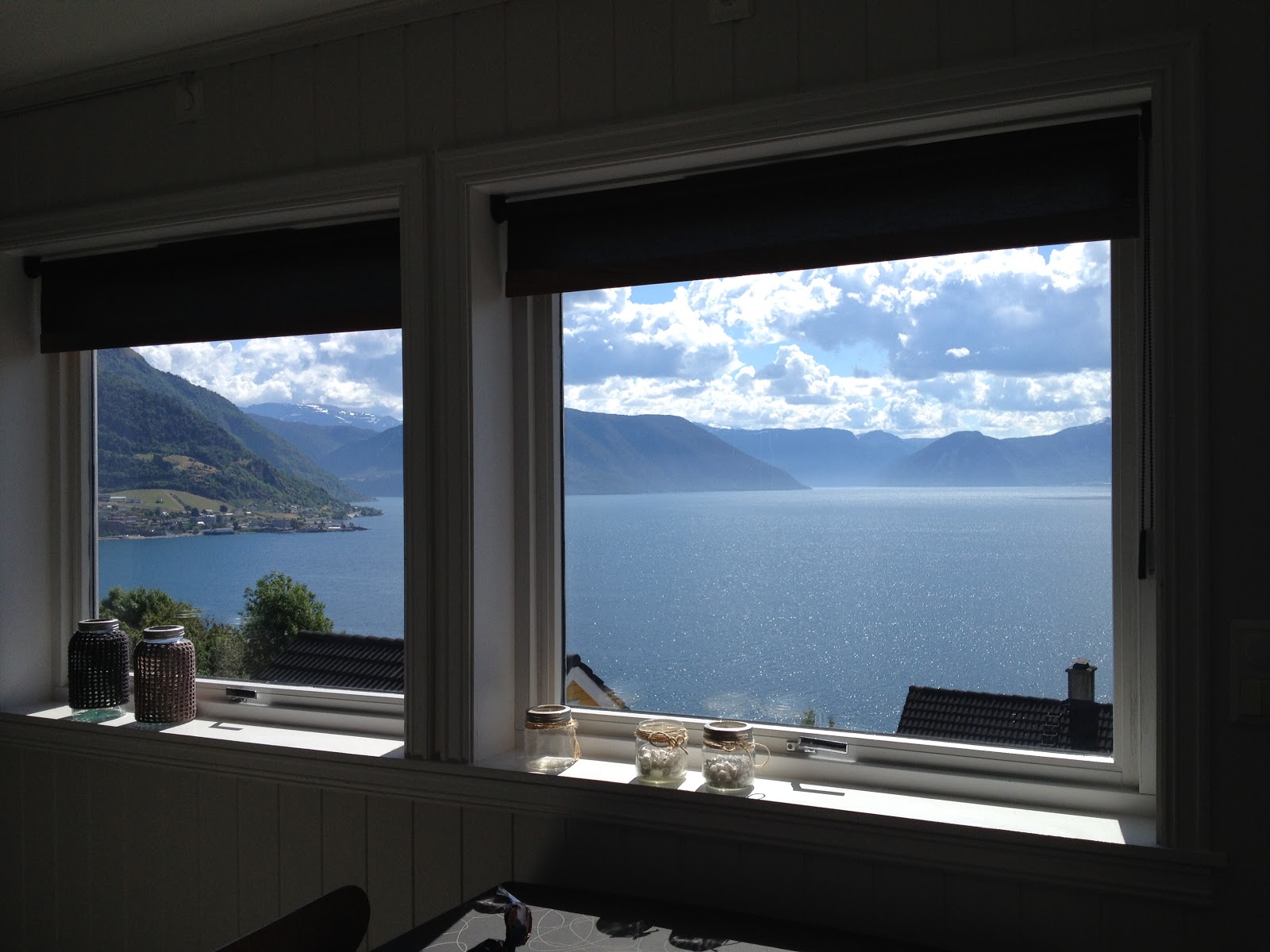
The house was heavenly, perched on a fairly steep hill with large windows in the kitchen/dining/living area offering breathtaking views of sky, sea, and mountains.  I never got tired of looking out of them.  

The moon at midnight

We were so inspired by the scenery that we wrote some haikus and painted with watercolors.
by Nerissa

by Zoe

Trevor's poem was about Vikings... 


Nigardsbreen at Jostedal Glacier

Our first big adventure was a blue ice walk on the Nigardsbreen arm of the Jostedal Glacier.  It was a warm and sunny day.  We took a short boat ride with our guide across the lake and walked to the retreating glacier.  

View from the car park.  Not too shabby

View towards the car park from the glacier.


Then we put on our crampons, harnesses, helmets, and ice picks.  
Wouldn't want to fall to our deaths into a crevasse now would we?


We were roped together so if one person fell, the others would fall, too.  Ha ha. 
It was like walking on a dirty snow cone.  

Ice which is very compacted and has few air bubbles absorbs red light and thus appears blue.


Some areas were steep but nothing particularly difficult.
Towards the end we found a blue ice cave to enter.  


The ice inside was very slippery and solid, not the crunchy granules of the outer glacier.  

Dream fulfilled.  What's next, climbing ice falls? 


Kayaking near Leikanger

Our generous hosts allowed us to use their community kayaks.  We biked down the hill and launched from the pebbly beach next to the elementary school.  The water was crystal clear but brisk.


H E A V E N

Families were picnicking next to the volleyball court and soccer pitch, all free for the community. What a life!

We even spotted a shy porpoise.  Just a dark fin that disappeared quickly.


The Geirangerfjord

 Our second adventure was an overnight trip to the Geirangerfjord, 
perhaps the most famous of them all because of it's narrow width and beautiful waterfalls.  
After another spectacular drive, filled with bucolic farmhouses and dramatic vistas, we made it to Hellesylt where we boarded the ferry to Geiranger.  


We stayed in a quaint cabin at the Geiranger Ferry Center, definitely recommended.  


SkageflÄ


For a small fee the ferry center took us in a small boat to SkageflĂ„, an abandoned farm clinging to the mountainside 820 feet up!   It has a jaw-dropping view of the seven sisters waterfall which in times of drought was the farm's only water source.  That meant a steep hike down, a brisk row across, and an uphill climb just to fetch water.  Talk about hardy pioneers!
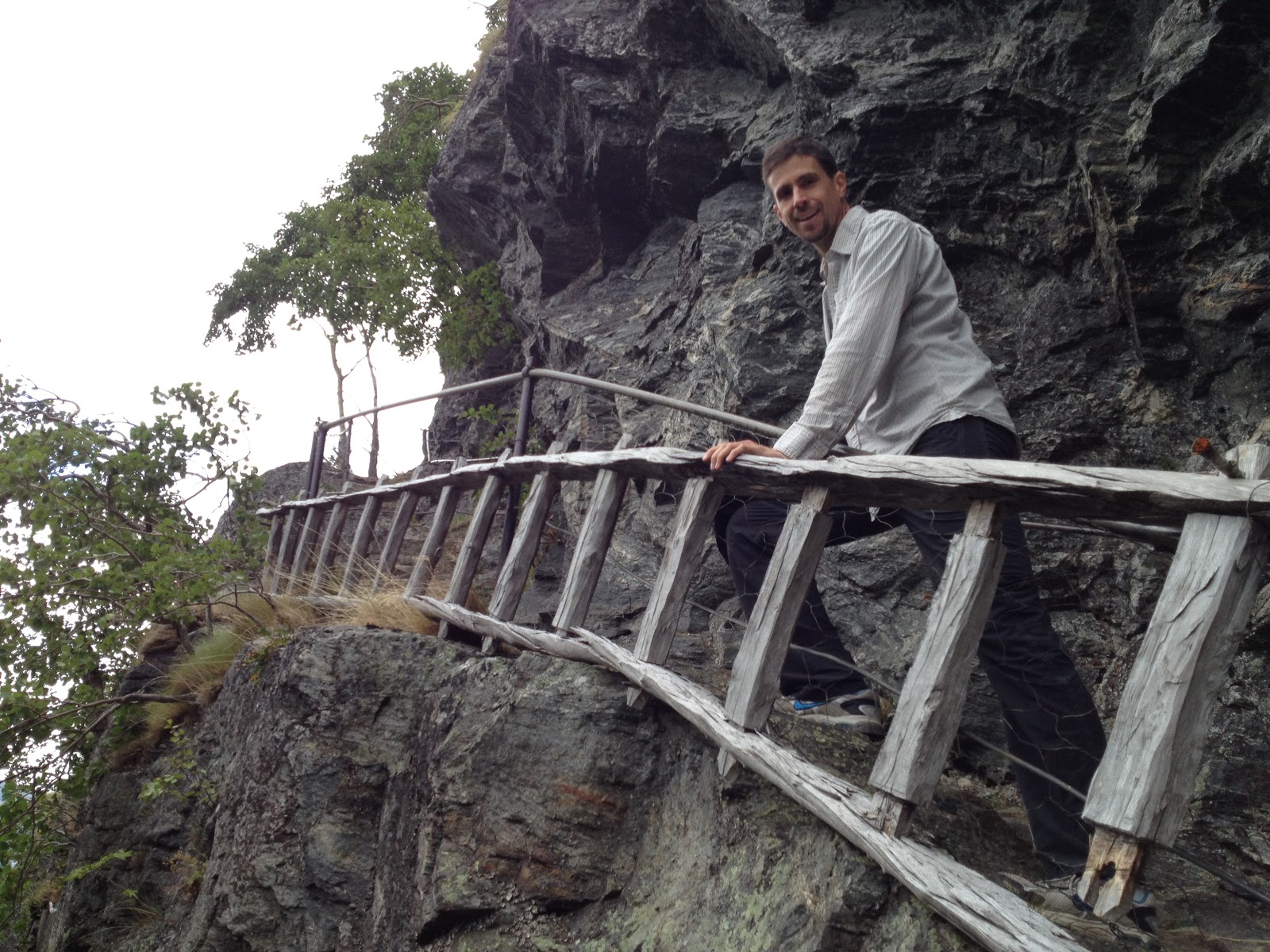
The trail up to the farm is narrow and steep-- difficult when it snows.  Talk about isolated.  

The family who lived here tied a rope to their children's waists and the other end to a big rock to make sure they didn't go falling off the cliff.  

Sod roof farmhouse.  Probably freezing in the winter.


It is said that once the family did not want to pay taxes, so when the tax collector came up the path, they removed the wooden ladder and he had to turn around and leave them alone.  
See how steep it is?!


Storseterfossen

Near Geiranger is the Storseter Waterfall which is reached by way of a short hike.  
You can actually walk behind the falls into the cave created by the erosion of the flow.  


Visiting with friendly sheep along the way.


Flydalsjuvet

On our way out of Geiranger we stopped at the Flydalsjuvet Vista Point which unfortunately has been made safer so you can't get that dramatic standing-on-a-precipice photo anymore.  But it is beautiful.


I love how nature can make you feel so small.


Dalsnibba

Dalsnibba is another famous viewpoint farther on the road, 
looking over the Geirangerfjord in the distance. 


Don't know the name of this river, but it was gushing and the most beautiful blue due to the silt it carries from the mountain.  Glorious!  
And walking through the pines over the mossy rocks was also so enchanting.


 Urnes Stave Church

We took a ferry from the quaint village of Solvorn across the Lusterfjord to Urnes where there is a famous wooden stave church from the 12th century.  I just adore the brightly colored wooden houses which felt so very midwestern American!  Obviously we copied them, not the other way around.


The small church has beautiful carvings in a Viking/Celtic influenced style.


Tvinefossen

We just stumbled upon this waterfall, which has got to be one of the most gorgeous natural falls I've ever seen.  You can just walk right up to it.


View over the Sognefjord


Bergen


The Bryggen, or waterfront. 

The history of the cod fishing industry in the North Sea is fascinating.  
We took a great tour and learned about the austere monastic life of the (German) Hanseatic League officers.  

This was the room/bed of the head honcho, which is basically just a closet to keep the warmth in winter because they had no heating!!!  The men and boys posted there were not allowed to marry or dally with local women, who were forbidden from certain parts of the wharf.  

 
All the world loves dried cod!  In Spain we call it bacalao.

It was the end of our two weeks in Norway, and I was so thoroughly charmed that I was ready to buy a Norweigan flag and apply for citizenship, until I saw the whale meat at the fish market.


Leproseet Museum

Leprosy is also known as Hansen's disease, after a Norwegian doctor who made great strides in the understanding of the disease.  The museum where they used to quarantine patients suffering from this then-incurable disease was sobering to say the least.

Leprosy is a slow-growing bacterial infection which causes parts of the body to die and fall off. 


To cheer ourselves up after that, we went for a walk.
The enchanted woods. 

The view from the top of the hill.


T and I will never forget the raspberries.  Growing wild everywhere, we picked and picked til our fingers were stained with red.  Small but sweet and juicy, we braved thorns and bugs for the succulent treats. 


Of all the incredible places we've visited in Europe, this one stays with me the most.  Yes, restaurants are ridiculously expensive.  But aside from that, the people speak English perfectly and really you just have to go.  In summer.  

Friday, June 5, 2015

Living Light

There is a movement afoot towards minimalism-- towards simplification.  A backlash against runaway consumerism that purports to make us happier but often ends up weighing us down.  A trend towards smaller houses, fewer belongings, and perhaps the end of self-storage.  Some do it because it's better for the environment (less packaging, transport, waste, energy costs).  Some because it's kind to your pocketbook, and thus your financial future (http://www.mrmoneymustache.com).  Some because a simple life is freer and easier in many ways.  There's less clutter, fewer decisions to make (which of the 20 different coffee capsule flavors do I want to buy?  Which have I tried? which have I liked or disliked?), fewer responsibilities to maintain our belongings, to keep them safe and in good repair.  That means more time to experience new things, fewer worries, freedom.  I like the idea of living lightly, although it is not always easy to do.

Here are some mind-blowing statistics about American consumption from the Becoming Minimalist website:

1. There are 300,000 items in the average American home (LA Times).
2. The average size of the American home has nearly tripled in size over the past 50 years (NPR).
3. And still, 1 out of every 10 Americans rent offsite storage—the fastest growing segment of the commercial real estate industry over the past four decades. (New York Times Magazine).
4. While 25% of people with two-car garages don’t have room to park cars inside them and 32% only have room for one vehicle. (U.S. Department of Energy).
5. The United States has upward of 50,000 storage facilities, more than five times the number of Starbucks. Currently, there is 7.3 square feet of self storage space for every man, woman and child in the nation. Thus, it is physically possible that every American could stand—all at the same time—under the total canopy of self storage roofing (SSA).
6. British research found that the average 10-year-old owns 238 toys but plays with just 12 daily (The Telegraph).
7. 3.1% of the world’s children live in America, but they own 40% of the toys consumed globally (UCLA).
8. The average American woman owns 30 outfits—one for every day of the month. In 1930, that figure was nine (Forbes).
9. The average American family spends $1,700 on clothes annually (Forbes).
10. While the average American throws away 65 pounds of clothing per year (Huffington Post).
11. Nearly half of American households don’t save any money (Business Insider).
12. Our homes have more television sets than people. And those television sets are turned on for more than a third of the day—eight hours, 14 minutes (USA Today).
13. Some reports indicate we consume twice as many material goods today as we did 50 years ago (The Story of Stuff).
14. Currently, the 12 percent of the world’s population that lives in North America and Western Europe account for 60 percent of private consumption spending, while the one-third living in South Asia and sub-Saharan Africa accounts for only 3.2 percent (Worldwatch Institute).
15. Americans spend more on shoes, jewelry, and watches ($100 billion) than on higher education (Psychology Today).
16. Shopping malls outnumber high schools. And 93% of teenage girls rank shopping as their favorite pastime (Affluenza).
17. Women will spend more than eight years of their lives shopping (The Daily Mail).
18. Over the course of our lifetime, we will spend a total of 3,680 hours or 153 days searching for misplaced items.The research found we lose up to nine items every day—or 198,743 in a lifetime. Phones, keys, sunglasses, and paperwork top the list (The Daily Mail).
19. Americans spend $1.2 trillion annually on nonessential goods—in other words, items they do not need (The Wall Street Journal).
20. The $8 billion home organization industry has more than doubled in size since the early 2000’s—growing at a staggering rate of 10% each year (Uppercase).

You know how bathrooms in Europe are tiny?  Well that's not all.  A large kitchen here is called an American kitchen.  In fact, people here live in much smaller spaces much closer together, which means less sprawl and more community interaction. Spaniards also have fewer domestic machines, and it's not for lack of technology.  Few people own clothes dryers (we did, but we managed for a few months by decorating all the heaters in the house with wet underwear) and even fewer own dishwashers.  I'm sure that saves a lot of energy and water.  Portion sizes are smaller, and there is no Costco.  That probably reduces food waste and overeating.  There certainly are few obese people here.  I think there is something we Americans can learn from all this.

We are in no ways living a minimalist life, but moving to Spain three years ago provided us with a great impetus and opportunity to pare down.  We decided NOT to store anything.  We managed to sell, donate, or stuff into attic and backyard shed ten years' worth of stuff that a family with two kids accumulates.  We arrived in Spain with 9 suitcases, and it was too much.  We hope to return home the with even less-- just clothes, passports, laptops and memories.

With this end in mind, we have built a very comfortable life here, trying to be mindful not to buy things we didn't need.  This flat is like a long-term hotel.  We borrow things we don't use often (like sleeping bags).  We make do (A fork is not only a fork, it serves just fine as a potato masher and a whisk!)We have 3 knives, one skillet, one large pot, and one small pot.  We've switched to ebooks.  The kids have very few toys, but they are just as happy.  I have to admit I have not pined for anything I left in California except for my friends and good Asian food.  I never would have imagined living 3 years without a car, but we've done it, thanks to amazing public transportation. Life here is simpler, slower.

And as much as I love this apartment and everything in it, I am going to let almost all of it go within a month.  But it is a wonderfully freeing feeling to be unattached in that Buddhist way.  "Thank you, bicycle, for serving me well, but goodbye."  I've been slowly selling everything in the apartment, and as it gets emptier and emptier I realize that I never really needed that nightstand.  We could have done with six fewer light fixtures, four fewer chairs and two fewer desks.  I can look pretty stylish with only 5 pairs of shoes.  I hope when we return to the States to our empty home in the 'burbs we'll be able to keep the garage completely devoid of clutter and continue to strive to reduce our footprints. Living light feels good.

Friday, April 10, 2015

Fer Pinya: Making Pinecone/Pineapple


In Catalan, pinya can mean either pinecone or pineapple, most likely because when the South-American fruit arrived in Spain from the New World,  it's spiky cone-shaped and fibonacci-patterned appearance reminded them of the Mediterranean pinecone.   To  fer pinya or "make pineapple/pinecone" means to work together; to rally in support; to gather in tightly like the radiating scales of a pinecone, each supporting one another.


See the resemblance?  

A common sight at festivals here in Catalunya are human towers or castells erected by castellers, groups of volunteers who train very hard to build amazing structures up to four stories high.  One of the best groups in the world are the Castellers of Vilafranca de PenedĂšs, a small town outside of Barcelona. 


Here is a photo of their impressive human castles

My hubby is a HUGE fan on castells and so I figured there was no better way to celebrate his birthday than with a surprise castellers workshop with 30 of our closest friends.  I told him we would visit and learn the history of the colla (group).  What he didn't know was that we would also be building a castell of our own.  He was more than a little surprised.  

David Miret served as cap de colla or head of the group from 2007-2011.  
This person directs the building of the castells from the ground.

We learned that the tradition of building human castles originated near Tarragona in the 1700s but only within the last 50 years has it become popular and spread throughout Catalunya.  More info about castellers in general here, and more about the Castellers de Vilafranca de PenedĂšs here.  

There are many ways to build a castell:  You could have levels composed of 1-5 people, stacked upon each other's shoulders.  The highest towers every successfully built are up to nine levels high! 


various types of structures

The child at the top is called the enxaneta or rider, and they raise their hand in the air with four fingers up, representing the four stripes on the catalan flag.  The person on whom the enxaneta sits is called the aixecador or riser. 

When I had viewed castells while standing in an overcrowded plaza during La MercĂš, I was always too far away and too short to get a good view.  When you are lucky enough to get up close, you can really see the faces of the castellers as they bear ever more weight and risk injury literally climbing on the backs of their teammates with bare feet.  You can watch the tower sway slightly, see the grimaces and the trembling limbs as they struggle to maintain their balance.  Rarely have we witnessed a tower collapsing, but it is really dramatic.  The children who climb to the top wear helmets.  One's fall is broken by the heads and shoulders of the pinya below.   I often wondered whether I could deal with the smell of so many sweaty people all mashed together.  Luckily, it was not a hot day.  

A castell in mid-collapse


I was really happy to see that our frinds were eager to participate and the mood was really jolly and cooperative.  The majority of our friends in attendance were Catalans who had never participated in building a castell before.  That kind of surprised me, but after thinking about it, it made perfect sense.  Hawaii, for example, invented surfing, and it is known throughout the world, but not many people who live in Hawaii actually surf.  Both of these activities require guts, strength and balance.


First, we all put on the long cummerbunds or faixas which support the back and 
also serve as a place for climbers to put their feet.


 Next we learned how to brace each other in various formations.

Then we worked on standing on the shoulders of others. 
Notice the look of terror on his face.

The kids had much less trouble with this.

You really have to trust the people you're working with.

Just standing alone on one person's shoulder was scary. I can't imagine climbing five times higher!!!


Here we are making the pinecone.  
The raised hands will hold the legs and butts of the people above to help stabilize them.  

The people on the outer layers press inwards and buttress the pinya.

Our final challenge was to build a two by four castell, which means four levels in total including the enxaneta, aixecador, a torre or tower of two people, and the pinya.  I was to be part of the torre.  I climbed up on my niece's knee and up on my brother-in-law's shoulders, and finally stood a friend's shoulders.  I did not even notice the many hands supporting my butt and legs as the two women climbed onto our shoulders.  I did notice, however, the pressure on my left shoulder.  


We did it!!!

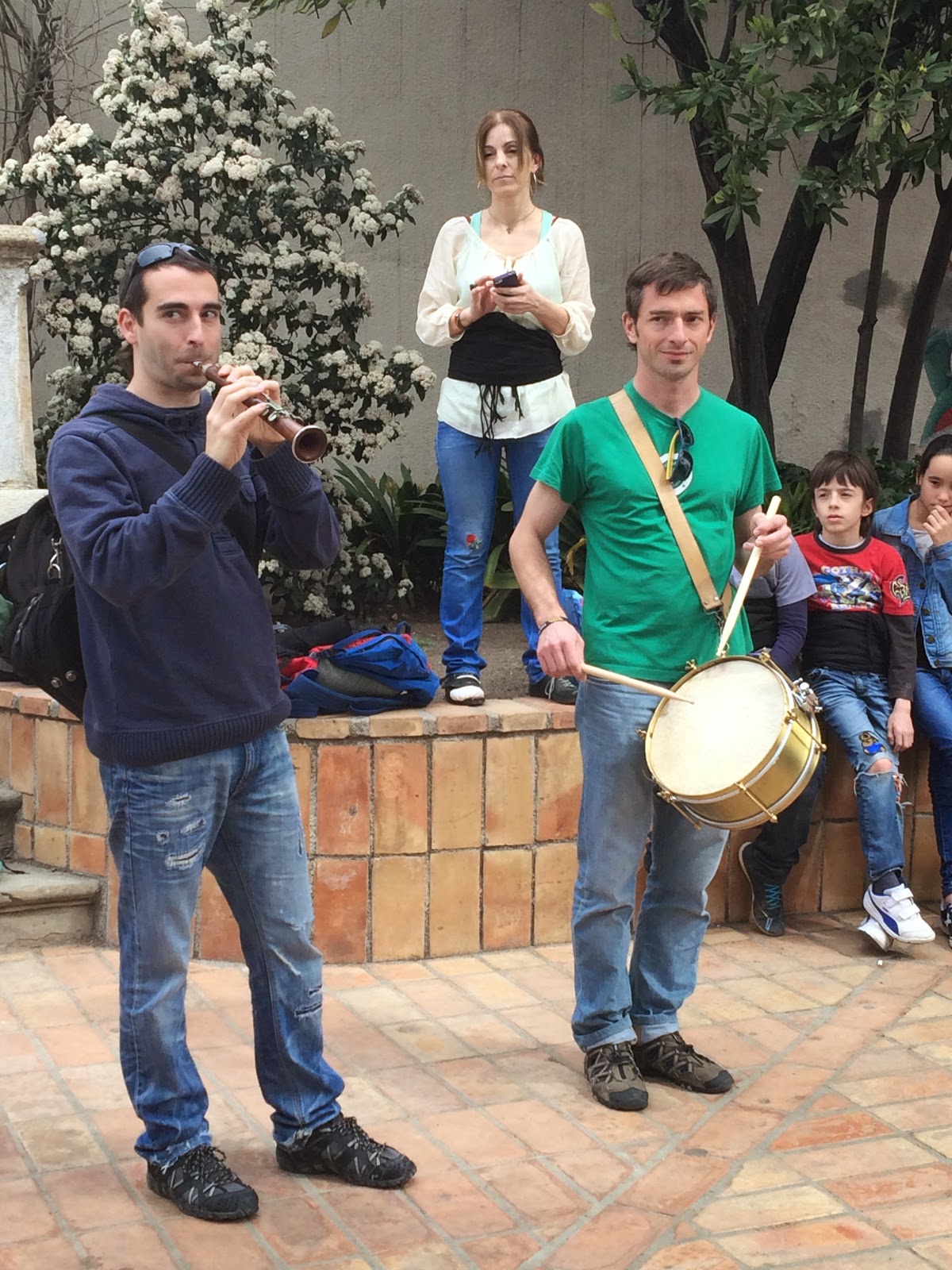
It would have destabilized me to look up and see what the two gals were doing up there, and doubtless for that reason castellers always are accompanied by a drummer and a gralla (like an oboe) player.  Specific tunes serve as signals for the ascent, the accomplishment of the castell, and the descent.  

The gralla and drum players


There is so much beauty in this activity: Firstly,  you take regular people with no particular physical skills, but by trusting each other and having courage, they are able to build something amazing. The contribution of each person is important to the endeavor, from the burliest guy to the tiniest kid. Secondly, it requires focus and dedication.  I was all smiles and laughs until the moment when the two women climbed onto my shoulders.  Then I put my game face on, and I did what in my flamenco class we call "touching the bottom," tocar fondo,  reaching into your reserves and drawing upon the strength you didn't know was there.  Building a castell is both an individual and a group challenge, and an adrenaline rush.  Often colla members spend years in the group, logging hours upon hours of practice, travel, and competitions.  The colla is a social and cultural organization and a symbol of community pride and unity.  All of these things make the experience so endearing to us-- a symbol of our three years here in Catalunya:  an experience of risk, trust, courage, friendship, hardship, solidarity, accomplishment and belonging.  


Our fantastic colla.


Monday, March 23, 2015

Managing Multilingualism


My mother speaks four languages: Fukinese (a Chinese dialect) which she spoke at home, Tagalog (Filipino) which she spoke growing up in Manila, Mandarin which she learned in K-12 Chinese school, and English which she learned a little in school but mostly upon arrival in the US at age 21. She speaks all four well enough to have fluent conversations and even business dealings in any of these languages, but I can only really judge her English, which is very lightly accented.  Only when she writes do her minor gramatical errors become evident.

My father speaks three tongues:  he grew up speaking Cantonese (another Chinese dialect) at home, learned Mandarin in school K-5, and English in school and upon arrival in the US at age 11.  He doesn't really read and write in Chinese anymore, but he can have fluent conversations in Mandarin and Cantonese.  His English has no real accent and he has an excellent vocabulary due to his high education level.  Despite having lived and worked in the US for the last 50 years, they both have maintained their multilingualism quite well.

I am a native English speaker.  I started studying Mandarin at age 10, and 30 years later I can manage to travel in China but can't read a newspaper or understand broadcast news.  Of course I have never lived immersed in Mandarin, so I haven't had the need to. Twelve years ago, when my daughter was born, my husband started speaking to her exclusively in Spanish, so I learned to understand a lot of nouns and phrases, mostly relating to diapers, food, hand-washing, animals, and the like.  I understood what he was saying to her, but understanding and speaking are two very different skills. Two years ago we arrived in Barcelona and I realized that I couldn't form a grammatical sentence in Spanish, so I enrolled myself in class and now I can survive and make friends.  It is discouraging to me how in such a short time I have been able to reach the same level of Spanish as it has taken me 30 years to achieve in Mandarin, but that is because English and Spanish have quite a lot of overlap while English and Mandarin have absolutely none.

I tried speaking exclusively Mandarin to our kids, and I did pretty well for the first three years with the first one.  My Mandarin improved a lot just trying to stay one step ahead of the children. However as the story always goes, my first child spoke only English to my second child, and after he showed some speech delays I switched to English with him as well, and it was all downhill from there.

We put the kids in Mandarin bilingual preschools and elementary schools, and spent a summer in Taiwan, and another in Yunnan to reinforce their Mandarin.  We hired Chinese or Spanish-speaking babysitters, attended Spanish and Mandarin music classes, and watched TV and movies almost exclusively in Spanish or Mandarin.  It wasn't too difficult in the San Francisco bay area where we lived, but it was a concerted effort which required time and resources.

Telling a joke in Mandarin
Singing in Mandarin

After ten years of formal Mandarin education, we decided to move to Spain to cement the Spanish foundation my husband had laid.  Mark, to his credit, was quite steadfast in his commitment to being Mr. Spanish.  For many years he spoke with a Latin-American accent which is favored in the US, but switched on a continental TH once we realized we were moving to Spain.  However, we chose to live in Barcelona, the capital of Catalunya, an autonomous community with it's own language, Catalan. Everyone here is bilingual at a minimum.

When they arrived at ages 8 and 10, the kids had literally never heard Catalan before, but within months they were reading and writing in it, and after two and a half years of immersion, they are conversing fluently and reading novels at grade level.  They attend a local private school which teaches in Catalan and Spanish, with English as a foreign language.  It's really incredible.  Thanks to their learning these languages early, they have good accents in all of them.  Because they are accustomed to being in a multilingual environment, they don't get tense or discouraged when they don't understand everything right away.  They just relax and pickup words here and there naturally.  I was surprised and proud that this year my daughter volunteered to be an announcer for the Carnaval show, which entailed memorizing numerous introductions in Catalan and performing them in front of the entire school, including parents.

singing in spanish
Presenting in Catalan


Now at 12, my daughter is just starting to surpass me in Mandarin vocabulary and comprehension. My son, on the other hand, has forgotten a lot in the last 2.5 years, but I don't blame him.  Mandarin seems useless here. Now that the kids have realized how easy romance languages are to learn compared to Mandarin, it is a little harder to motivate them.

In California, my son refused to speak Spanish.  Now he refuses to speak Mandarin.  I feel like I have spent the last 12 years doing a juggling act, doing my best to keep three linguistic balls in the air.   It can be rather tiring always trying to keep their language skills in balance, always reinforcing their literacy and fluency in something.  I am an educator by training and by nature.  When I noticed their English vocabularies were a little weak and they were not reading for pleasure independently, I started reading aloud with them to build their confidence and get them hooked on reading.  I'm absolutely convinced that reading for pleasure is the best way to improve spelling, vocabulary and grammar in a natural way, without realizing it.  I see now that since they never got hooked on reading independently in Mandarin, they will perhaps never reach a native level of vocabulary or literacy.  However, if someday they spend a year living in a Mandarin-speaking country, they will become fluent conversationalists.  I assign mommy homework and they hate it.  We have vocabulary words on the wall next to the dining table.  Movies are always viewed after reading the book.  I strive to keep Mandarin alive one hour per week.  I can tell that living here my own Mandarin has gone to pot, and even my English has suffered!  Sometimes I can only think of the Spanish word for something, and I have started spelling words which end in -tion with a -cion.  The truth is that in order to maintain literacy and fluency, you have to keep speaking, reading, and practicing constantly. Juggling is difficult to learn at first, but I hope once we reach a certain aptitude, it will get easier.

Right now our daughter's English sounds quite native, but our 10-year-old son speaks with some Spanish-isms which are kind of cute or funny.  Sometimes he turns Spanish words into English, like when he said, "I think he was just dissimulating (lying)." or "We wore winter hats in plain summer. (pleno = in the middle of)"  Other times uses Spanish grammar which speaking English.  For example, he often puts THAT (que) at the beginning of his utterances, "That you need to sign my test,"  which is not something a native English speaker would do.  His sentences make perfect sense in Spanish.  Example:  "It already passed 10 minutes? (10 minutes have already passed?)" or "They always put us a salad, (they always serve us salad)."  English remains the most important language for them to master, but we have faith that when we return to California for middle school, within a year or so their slightly imperfect English will be refined and polished.

I know they are proud of themselves, and they know that being quadrilingual is an asset.  The jury is still out over whether and how it may serve them in the future, but for my husband, a certified linguistic geek, and for myself, it has been a life-enriching challenge for us all.  We will keep on juggling.


Saturday, January 31, 2015

Seeing America Differently

I've always been very patriotic.  Corny as it may sound, as a kid, singing America the Beautiful in school assemblies sometimes made me teary-eyed.  I think it is because America is the country which granted my parents, through their ceaseless hard work and intelligence, the American Dream.  They came as penniless immigrants with minimal English skills and will retire successful and respected professionals and parents of children with advanced degrees.

And although I have at times felt ashamed of some of the actions of my country (CIA shenanigans) or hopeless about various issues that plague our society (ongoing racial discrimination), I've always considered the US of A the best country in the world, and my home sweet home.  Now, after two and a half years of living outside the country, I am for the first time feeling just a little less certain about the superiority of the EEUU, as they call it here.  Note that  I am speaking from my view as an educated upper-middle-class person who came from the Silicon Valley, one of the most competitive environments in the US, if not the world.  I just see the US from a different perspective now.

The economy here in Spain is not doing well.  Salaries in Mark's line of work are very low, less than half of what he would earn in the US.  There is more bureaucracy and regulation.  For example, a group of retail merchants on the most famous shopping street in the city recently petitioned the government to allow them to open for a few hours on Sundays.  It seems like a no-brainer to us, that with hordes of tourists looking to spend their money and an economic crisis in full swing, it ought to be up to the stores themselves to decide whether such a move would be profitable, but that's a very American perspective. Flexibility and efficiency is one of the best things about the US, I think.  On the other hand, protecting Sundays not for religious reasons but as a family day of rest and togetherness free from commercialism is rather beautiful.  Spaniards really do celebrate every cousin's birthday together, and have long family lunches every week.  I believe that type of strong family support is really healthy.

The fact that there is free, decent quality health care for all is really a tremendous relief.  Many people still opt for private health insurance, because it means no waiting times, and it is in fact quite affordable (for a family of four, less than $200 per month with minimal copays and no deductible!).  Most doctors work for both the public and private sector, and in fact the best doctors are in the the public hospitals, so if you have a serious concern, you go there.  Spain definitely wins in the health care department.

The work environment here is not particularly demanding.  People don't derive their identities from their work, and never talk about it outside the office.  It seems to just be something they do to pay the bills.  Things happen more slowly, and people are generally patient and understanding.  Apparently Spain has lower productivity than countries such as France and Germany, and that may be somewhat due to the long, fragmented work schedule, starting at 9, with numerous coffee and lunch breaks, but stretching to 5 or 8 at night.  This needs to change in order for the country to be competitive economically with the rest of Europe.

While we find people here well-educated and very competent, they are not necessarily striving for excellence or particularly dedicated to their work.  This complacency allows for inefficiency or mediocrity, and it can be annoying.  For example, when our wall became damaged by a minor water leak, I called my landlord.  She called the insurance company who manages the maintenance of the apartment.  They called me to set up an appointment for someone to look at it.  The guy came and filed a report.  Weeks later someone else came to look at it, but said he couldn't do anything.  So they sent another inspector.  Filed a report.  It's been two months, three people have come, but still nothing is fixed.  ???

The flip side of this is that when people are off work, they can generally disconnect.  There is time in the evening for socializing or relaxing.  The pace of life is slower.  There is time to stop and chat when you run into someone at the store.  Personally, I think this is very healthy.  In California I always felt like I was racing from one place to another.   I worry that when we return to the states the fast pace and competitiveness will come as a shock.  The quality of life here is definitely better. There is much less anxiety.   These people are not workaholics.  They put human relationships before money.

Our Bay Area friends have reported that applying for private middle schools is "a campaign" involving parent interviews, essays, letters of recommendation, standardized tests, student interviews, and more.  The pressure of SAT tests, APs, etc. seem to be driving Palo Alto teens to suicide, and it's really frightening.  Here, if you test well, you will get into a good public college that doesn't cost much.  There is much less competition.  Spain does not score high on world education rankings, but at least their kids are not self-destructing.  American competition these days seems overly cut-throat and inhumane.

Spain is not perfect.  There is racial discrimination against gypsies, muslims, and dark-skinned immigrants that needs to be addressed.  Unemployment is high and too many people are losing their homes.  Gender inequality is still pervasive, although there are many more female political leaders in Spain than in the US.  But gays can marry here, and there is virtually no gun violence because GUNS ARE ILLEGAL.  Imagine that!  Public transportation is really for all sectors of the public, not just the lower class.  All these things make me sad when I contemplate returning to California where traffic jams, mass shootings, stress-ed out students, overworked parents, and ridiculously high insurance premiums await me.


Monday, September 15, 2014

Choosing Foreignness

Last week the thought occurred to me, "I feel happy today.  Really and truly happy." It was a feeling of lightness, like a revelation.

It's not that I have been unhappy over the past 20 months of living in Barcelona, but it has been challenging in many ways.  I chose this challenge, and I thus I have faced it in my very rational way, constantly reminding myself of how lucky I am, eyes ever fixed on my daily to-do list.

It often happens with me that I don't realize how I feel about things until there is a change of state.  For example, I didn't realize how insecure I was as a child until I grew into self-assurance and could look back on myself with some perspective.  When I was a teacher, I knew I was working hard and that I struggled with certain aspects of the job, but I didn't realize how stressed I was until I stopped teaching. I think I am just the type of person who can tolerate emotional discomfort for long periods of time without realizing it.

That is probably a good thing, because becoming a foreigner in middle age is not a comfortable thing to do.  It's completely different from being a tourist and observing an unfamiliar culture from inside your protective bubble,  knowing that you will be home soon enough.  Becoming a foreigner is to choose to be an other;  an alien, a curiosity, a minority.  It carries a certain psychological burden.

If your home country is a powerful one, and you have money or status, then it's easier, because you are likely to feel welcomed and perhaps in some ways superior to the people or culture of your host country.  Although if the differential is too great, you may feel suspicious that people are being nice to you in order to get something from you, and that's not conducive to building real friendships and trust.  That is why we did not choose to move to an underdeveloped country.

If you come from a country which is more or less equally powerful as your host country, then there is a pleasant mutual respect.  The difference in culture is novel and interesting, and you can exchange recipes and ideas freely.  This is the situation we are in, and it's fantastic.  Many people want to learn English, and there have not been large differences in culture to navigate.

If your home country is a poor or troubled one, however, then the locals know you're vulnerable. You are here to work, and you have the burden on your shoulders of adjusting and integrating to the dominant culture.  They may look down on you,  or pity you.  Your customs, dress, and language may seem strange or backwards.  For example, I think about how it must be hard for muslim Pakistanis here: The women stand out like sore thumbs in their headscarves, and imagine trying to eat out when everything contains ham!  Those immigrants have every possible hurdle to jump:  language, culture, religion, and race.

The Spanish generally like Americans because they are familiar with our music and movies.  If they idolize America as a land of opportunity, they may ask, "Why have you come here?  Isn't life good where you came from?"  The locals know they have it good, with the Mediterranean beaches, the food, the weather, the social security... they wouldn't dream of uprooting themselves unless faced with the prospect of war.  They like the idea of visiting New York, Los Angeles, Las Vegas, and Hawaii, but they wouldn't necessarily want to live in what they think of as bible-thumping, gun-toting, crime-ridden, ultra-competitive America.

Of course people don't think I'm from America because of my face.  Often they assume I'm from Japan or China.  Unlike my husband, who can pass as a Spaniard on the street with his brown hair and eyes, I feel very conspicuous.  There is a growing community of Spanish Chinese, but the generation born here is still under 18.  I have no hope of looking local, so my foreignness can never be concealed, it's a part of my identity here.  It's not that I feel discriminated against here at all, but naturally they expect less of me here.

Growing up in Hawaii, I never had the feeling that I did not belong in America.  My America was a multiracial one, and living in northern California only strengthened that belief.  Although I have gotten used to being often the only Asian in the room here, I look forward to returning to California in part just to feel inconspicuous again.

I did not anticipate how so many inconsequential unknowns can add up to a low but constant level of stress.  Not knowing where to buy school supplies, how to get anywhere, where to get your hair cut, whether and how much to tip the stylist, or what company to use for internet service... all very minor concerns, but when added up make everyday living just a little more difficult.

It took me over a year to feel like I actually live here, to not feel like a tourist somehow.  It takes time to make real friends,  especially if there is a language barrier, so the first year I was surrounded by acquaintances.  I clung to any English-speakers I knew just to have someone to talk to, or any friendly Spanish people who showed an interest.  Over time real friendships have blossomed and deepened, and now I feel truly valued here.  Yet until I am really fluent in the language, I will continue to feel a bit disempowered, and not quite at home.  However, I do not regret this experience one bit.

Burkas in Munich

In Munich this summer we noticed a lot of women on the street in chador*, the generally black Muslim robes which cover everything but the hands, feet, and eyes.  (*Note that these terms are used differently in various countries)


Naturally I have seen photos of women wearing these before.  When I traveled to Malaysia I saw many women with hijabs* or scarves covering their heads, and the effect can be colorful and attractive.

But seeing the full-length jet-black chador on the street in the middle of a modern european city in summer had a strong impact on me.  The solid black color makes a stark visual statement, especially in contrast with the other people around in casual western dress.  Especially, as was often the case, if the woman in chador was accompanied by her husband and children, who were conspicuously NOT in traditional dress, but in normal western clothing.  "Why," I thought to myself, "have the men and children integrated into modern society while the women remain apart, isolated, stuck in the past? How must those young girls feel the day they can no longer run freely and must set themselves apart?"


I am not a religious person, but I am a liberal person who tries to be tolerant of differences of opinion and belief.  I try my best not to have prejudices, but like all humans, I come with the cultural baggage of being an American who lived through 9/11, Saddam Hussein, Osama bin Laden, and the Boston Marathon bombings.  In addition, as a feminist I found it very hard not to feel disturbed seeing these women enveloped in blackness.  It was very hard not to feel judgement.  Their children looked happy in their strollers,  on the playgrounds, and in the parks.  I wanted very much to see these families as similar to our own, yet I could not overcome my feelings of sadness.  I hope that the women wearing the chador feel that they freely chose to do so.  I hope they do not feel it a burden or a limitation.  But I can't help but feel that it MUST be one.  Bulky clothing does restrict a person's movements.  It makes it hard to play sports, to swim, and be active, which is one of the joys of my life.  Feeling the power of one's own body seems to me a human right.

A few times we noticed women wearing a kind of metal mask over their noses and mouths.  It looked a bit like a beak, and frankly it was a little frightening to look at.  I did a bit of research, and found that these are called burqa* and are common in the United Arab Emirates.


I'm sure they can be made to look beautiful, alluring, exotic, and mysterious.  However, I had a hard time not imagining that it might be hard to breathe or speak with something over my nose and mouth.

In this kind of burkha it must be hard to see clearly and I imagine it to be stifling in hot weather.

I can't help but think of footbinding, a despicable practice, now illegal and no longer done, in ancient China where girl's feet were broken and bound into tiny hoof-like shapes, to make them more desirable (and less mobile).  "Golden lily" feet were actually considered erotic.  Some cultural practices need to be discontinued simply because they are oppressive.

In the west, people only cover their faces in hospitals, during Halloween or Carnival, or when committing crimes.  I think it naturally triggers suspicion to see someone walking around with their face covered, as if they have something to hide.  It's a cultural bias, I recognize, but it does tend to make an unknown stranger seem less trustworthy.  I have heard some women who choose to cover themselves like the feeling of freedom from the sometimes preying eyes of men, that they don't feel like their bodies and appearances are constantly being judged as attractive or unattractive.  I think that argument is valid, although in the West they are likely to be judged for their religious belief instead.

It is terrible, but on a rainy day at the playground, a women in a black chador in the distance was gesticulating with her black umbrella, and for a brief moment it flashed through my husband's mind that she might have a weapon.  One can't deny that baggy robes would make it easy to hide things like weapons and bombs, and on the bus to the airport it again crossed my mind as I sat across from a woman in black.  "I hope she is not a suicide bomber.  I hope she is just a normal woman like me."

I am a bit ashamed to admit to having had these thoughts, and yet I think we should talk about these things, air our dirty laundry and let the sun shine on our humanity.  When I see a woman in a chador, this is what I see:


In April 2011 France passed a law which bans full-body coverings such as burqas and chadors, for security reasons as well as cultural integration.  Apparently they do not have such strong views on freedom of religion in that country.  I doubt that would fly in the US, but if we had a large influx of orthodox muslim immigrants to the country, I can imagine the conflicts that would cause.

I want for women everywhere to feel equally valuable, equally free to learn, to make, to do, to drive, to write, to read, to dream, to sing, to dance, to own, to earn, to travel alone, to choose their own spouse, to vote, to choose their own clothing, to have control over their own destinies.  Is that me imposing my western values on my muslim sisters, or is that what they also want for themselves?