Sunday, June 16, 2013

Anthropological Observations

The Spanish are extremely sociable.  

When one enters a small store, the proprietor will always say hello, and you are expected to do the same.  When riding in an elevator, upon leaving it is customary to say goodbye, even if you do not know the people you are riding with.  They recognize each other's humanity.  Of course in a large city one does not walk around greeting passersby, but within our apartment building we do chat with the neighbors.

The standard greeting between women or between a man and woman is two kisses-- one on each cheek (or the air, with cheeks touching), beginning with the right side and then the left.  For men, handshakes with an additional arm or shoulder pat.  When in a large group, it can take some time for each person to make their entrance with the whole greeting-and-kissing routine all the way around.  And farewells are even more drawn out.  In California, we were rather accustomed to just closing conversation, giving a goodbye hug, turning and leaving.  But here there is lots of lingering, more jokes and conversation, saying goodbye and kissing everyone present, and a slow mosey to the door with parting wave.  It would be considered very rude to leave without saying goodbye, even at a large gathering.

Lunches and dinners can last for hours.  In restaurants it is standard to get a starter, a main course, and often dessert, followed by coffee.  The food can take awhile to come out, and the sobremesa, or table conversation, is very important.  This was difficult for me at first, since I did not understand everything that was being said, and being linguistically hamstrung made it hard for me to make jokes or display my usual charm and effervescence.  At first, after a few hours of Spanish immersion, my head would hurt.  Now I am following the conversation more, although jokes are still difficult.   People here really like to talk.  They are happy to spend an afternoon walking along the beach or in the park while the kids play for a few hours, and then spend two more hours chatting over a long lunch and calling it a day.  Perhaps more banter and drinks after dinner, and don't expect guests to leave your house earlier than midnight.  They might not leave until 2am.

Mark and I are small group people.  We like intimate conversations.  The Spanish seem to have a "the more the merrier" attitude.  If you plan an outing with one family, don't be surprised if four families show up.  It seems fair game to invite others along.

We have met very few people here with poor social skills.  Perhaps coming from the Silicon Valley with it's high concentration of engineers, our estimation of normal is a little skewed towards the nerdy.  But we have been very impressed even with the children, who look us in the eye, greet us, and seem quite confident in themselves.  We are a bit embarrassed that our kids are a shy with adults and have a hard time holding eye contact, even with people they know quite well.  They have no problem with other kids, but when faced with an adult they freeze up like deer in headlights.  We encourage them to make conversation, and do plenty of modeling, so we're not sure why we have such timid progeny.  Well, I was a very shy kid myself, and not particularly socially skilled, so perhaps there is hope for them yet.

The cultural norm for physical proximity is closer here than in the US.  It is certainly difficult for people from Asian cultures who generally do not touch each other and aren't so very warm and effusive to assimilate here.  One American mother we spoke with said her boys had some difficulty adjusting to the physicality of the playground in Spain.  The kids like to touch each other when playing.  Luckily, our kids have not had any problems adjusting to this.  It will be interesting to see whether when we return they notice any differences.

You know how in the South people often call strangers "Honey" or "Darling" and it's so warm and quaint?  Well here they say "Guapo" or "Guapa" which literally mean "good looking."  At first when a man said that to me, I wasn't sure how to understand it, but it's very common to use with strangers and people of any gender.  I like to throw that one in to feel a little less square.  With their children or loved ones, they use some very sweet terms of endearment, such as cariño (dear) , mi vida (my life), and mi cielo (heaven/sky). The language is rather effusive.  Whereas in the US we might say things are cool, nice, great, fun, or awesome, in Spain things are perfecto, maravilloso, fantástico, buenísimo, or estupendo.  In addition, people here LOVE emoticons.        Many at one time. Even men are not embarrassed to employ them.   I guess it's all part of their sentimental, expressive nature.

A word one hears all the time is vale, which means OK.  That one was easy to incorporate.  One word which I understand the use of but haven't yet managed to employ myself is the word hombre, which literally means "man" but is used to kind of like the way we use the word "dude," often at the beginning of a statement where one is expressing a strong feeling.  Like, "Dude, what are you thinking?" Even though it means "man," women use it with each other all the time as well.   Trevor uses the word tío (which literally means "uncle") with his friends again the way we might use the word "dude" in a sentence like, "Dude, you are totally getting killed in that videogame."

When speaking, people here do a lot of shrugging.  Not a quick, "I don't know" kind of movement, but a sustained, multiple-sentence-long shrug with hands palms up which expresses, "I can't do anything about it but this is the way it is."  Mark is good at this one.  They also often touch their index finger just below one eye and pull down slightly on the skin when they talk about looking or seeing or watching something.  Spaniards also like to throw a little tongue-teeth "tsk" into the middle of their sentences, which mean they are about to say something negative.  For example, "I mean, tsk, that is not how I would do it."  

It's funny to hear what stereotypes Spaniards have of Americans, based on movies, television, and the news.  They imagine that we all live in single-family houses with lawns, in towns with wide streets with sidewalks, with American flags hanging from every home.  They think we barbecue in the backyard a lot, and drive our cars everywhere.  They think we are religious and conservative, anti-gay, and obese.  And they think that Americans tend to be unabashed salesmen-- unafraid to appear arrogant by talking about their own accomplishments.

The Spanish have a certain amount of dignity.  Businesspeople don't debase themselves by appearing overly eager to sell you things.  Each shop has one tastefully discreet sign (The opposite of Taiwan, where commerce is everywhere you look, and tasteful aesthetics take a backseat).  If you like what they have and want to buy it, great, but they aren't chasing after your business.  Waiters and shopkeepers are sometimes surly, sometimes cordial, but never obsequious.  True, especially in the tourist area, there may be someone standing outside of a restaurant asking whether you'd like to come it.  Another common practice for businesses is having people pass out flyers to pedestrians.  But on the whole, they like the soft sell, and are not at all pushy.  People do not generally talk about their work unless you ask them about it.

All told, we are finding it quite easy to feel at home and comfortable here.  It will be interesting next month when we spend two weeks in Germany, to see how people are different there.  We have heard a lot about how the Germans are less friendly, more serious, and more rigid than the Spaniards, so stay tuned...


Thursday, June 13, 2013

The Ubiquitous Woman

Mark has an amazing memory for faces.  Two years ago, he claims, he started noticing the same woman appearing in numerous ads for all types of products:  health clubs,  dentists, vacations, you name it.  At first I did not believe him, but now it's irrefutable.  This woman is everywhere.


She is young, well-groomed, Asian mixed race, with long brown hair, and a very friendly smile. She has a very happy and warm look to her.

       
Shop window in Barcelona, June 2013                           

In the supermarket, June 2013, Barcelona

And not only was she appearing in the United States, but in the 9 months we've lived here in Spain, we have seen Her on buses, in metro stations, in shop windows, and in our junkmail. She even followed us to Holland!  We seriously think that She is the most viewed woman in the western world.

Shampoo add in Holland, May 2013

But who is She?  I think She is completely unknown, even though her image has been circulating the globe.  And this is my theory for how She became such a ubiquitous yet anonymous face:  A web search for "stock photos" comes up with hundreds of images of Her in various locations and situations. The photos are high quality, and many have a white background which is a very clean and modern look, easy to manipulate.  She has cleverly posed holding blank cards or looking to the side-- perfect for inserting ad copy.  For a few dollars anyone can buy a high-quality photo of Her to use in advertising their product or business, because She has given up her rights to royalties.


I feel like a stalker, but as an amateur sleuth I am guessing that because the photographer is listed as Maridav, her name either is or starts with Mar, and perhaps the man who appears in many of the photos with her (always the same guy) must be her husband or boyfriend, who might even be named David.  There are an awful lot of photos of them running, so I'm guessing they do a lot of exercising.


I've seen her so often, that I feel as if I know her.  My dream is to meet her in person one day.  Can anyone help me meet the mystery woman?!?  If you spot her, snap a photo and send it to me with the date and location!!!

Monday, April 29, 2013

Eating Vegan In Barcelona

I am not vegan, but my hubby and kids are.

There are a good number of vegan and vegetarian restaurants in the city, which is to be expected in a metropolitan area with international influences.  We have made a google map of vegetarian-friendly restaurants in the city which you are welcome to use.  We have not tried all of the restaurants listed, but it's handy when you are out and hungry and want to find a place close by.  Of these, our favorites are Teresa Carles, Addis Abeba (Ethiopian), Veggie Garden, Sesamo, L'Hortet, Maoz, and Biocenter.

Of course a hungry vegan can also go to just about any Thai, Chinese, or Indian restaurant, but note that many Chinese places, though abundant, are not very authentic and may not carry tofu or Chinese greens.  I'm sorry to say, compared to the California Bay Area, the international cuisine here has not been quite up to snuff.  Catalunya is a bit like Italy in that they love their own food and are happy to eat it every day for every meal, and other cuisines tend to adapt their foods to suit Spanish tastes.

Awareness and understanding of veganism amongst the general population is not very high.  For example, when our kids go to parties or to a friend's house, I will often provide food for them since sometimes people are hard-pressed to come up with vegan options on their own.

One cannot really just go to any old restaurant and expect to find enough food to make a meal.  But here are some typical local dishes which are generally vegan:

 Aside from the obvious: patatas fritas (french fries), salad, bread, olives, hummus, and guacamole, look for these treats:

     
     pimientos de padron a la plancha                   
     grilled padron peppers                                 
     fantastic!

pa amb tomaquet
pan con tomate
bread with tomato, olive oil, and salt
simple but delicious

Setas a la plancha
Grilled mushrooms with garlic and parsley
More common in the fall.  Delicious!

Alcachofas al horno
Baked artichokes with salt, pepper, and olive oil
    Bueníssimo!

  Escalivada
  Oven roasted onions, sweet peppers, & eggplant
 Swimming in olive oil

 Patatas bravas
       Oven fried potatoes with spicy tomato sauce and aioli.  
Aioli is garlic mayonnaise, which sometimes contains egg, so ask.
Famous for a reason.  

And if you are around in March, try the calçots, a type of onion, like a cross between a green onion and a leek in that it has flat leaves rather than round, and they bury the bottom to keep it pale and tender.  The are roasted over an open fire until they are complete black on the outside and soft on the inside.  At a Calçotada (a traditional onion roasting party), one peels off the outer layer and dips what looks like a banana slug into the special sauce (Salsa de Calçots, a type of Romesco made of tomato, garlic, almonds, olive oil, and spices) then savors the sweet flavor.  Your hands get all black.  It's lots of fun, and tastes amazing. 


In addition fresh fruits of excellent quality are available everywhere.   Most restaurants offer a menú (a menu of your choice consisting of an entree, a main course, drink, and dessert) which includes a postre (dessert) and they will have fresh fruit as an option.  

Buen provecho!


Thursday, April 25, 2013

Learning Spanish Take Two

OK, I knew I'd have to pay for my cockiness the last time I wrote about learning Spanish...

Let me just say that the honeymoon is over.  Level 3 is a real step up from level 2.  I am encountering lots of new vocabulary, and many of my classmates speak quite well, while I often feel tongue-tied.

It doesn't help that I arrive late to class twice a week because of my dance class schedule, and I leave early on Mondays in order to take Trevor to guitar class.

I seriously feel like I speak worse now than when I just arrived.  Mark says that isn't true, and he thinks I am improving.  But I feel more embarrassed now than just two months ago hearing myself butcher the language every time I open my mouth.  I think at first I was just happy that people seemed to understand what I meant, and I didn't know how to speak grammatically, so I just said whatever came to mind and didn't worry about it.  Now I know when I have used the wrong tense and I have to pause in the middle of my sentences to figure out how to form the verbs correctly, and I see the slightly strained look on the faces of the people I am talking to and get even more self-conscious.  It's not good.

My brain is full!  Suddenly words which I know that I know are harder to recall.  Have I been drinking too much wine?  Listening exercises have become more challenging.  I cannot understand people with Andalusian or Caribbean accents.  I get the general idea, but miss the subtleties because they are talking so damn fast. I hate that I can't understand jokes, and it's hard to make jokes.

Now that I know 4 different kinds of past tense, I not only have to figure out when to use them, but also how to form each verb in that tense, depending on whether it's first person singular, second person, third person, first person plural, second person plural, or third person plural!  Should I use the preterito indefinido (distant, completed past) or the preterito perfecto (recent, continuing past) or the preterito imperfecto (describing the past), or the pluscuamperfecto (past tense of the past)?  Telling one story often requires switching back and forth between all of these.  Yikes!

In addition to the present tense, we have the future tense, the imperative, and the subjunctive, each with their own sets of irregularities.  Adding to the complexity of verbal conjugation, once must consider, is the verb reflexive?  Because the meaning changes a lot if you leave out one tiny pronoun.  For example, cambiar means "to change," but cambiarse is "to change one's clothes". Quedar is "to meet with someone," but quedarse is "to stay in one place for awhile."  

If I manage to get the verb right, I still have to worry about matching nouns, adjectives, and articles according to the number and gender of the object, which sounds easy at first glance, but there are enough exceptions to make it complicated.  La mano and el poema are masculine, but el agua and la foto are feminine, while el paraguas and el microondas are both masculine and singular!  Argh!!!

One of my least favorite things are pronouns, which vary depending on whether they are subject, direct object, or indirect object, male, female, singular, or plural.  Do they go in front of the verb or behind it?

I also have a hard time with prepositions-- those tiny linking words which you just have to hear enough times to have a feel for what sounds natural.  Should I use de or a or para or por or con?  They all can mean "for/to/with/at."  Finally, there are those pesky accent marks.

*sigh*

Can you tell I'm a little frustrated?

Sometimes it's not good to have high expectations of yourself, I guess.

I have about a month to review and prepare for my exams.  Wish me luck.


Monday, February 18, 2013

Chinese New Year at Pérez Iborra

Every year the elementary students at Z & T's school have the option of spending three nights away from home skiing.  The kids who do not go on the ski trip still attend school, but there is not much new instruction taking place at that time.  Since our kids did not participate in the ski trip, and Chinese New Year this year happened to be during the exact same time, I asked the school whether they might be interested in spending the week learning about and celebrating Chinese New Year.


The school offers a once-a-week after school Mandarin class,  there is one adopted Chinese student, and a few students from Chinese families, but these are a very small minority.  In Barcelona there is a considerable and growing population of mainland Chinese immigrants, but they report that the New Year is not really celebrated here.  Chinese families have large meals together, but that about sums it up.


Since I have coordinated Chinese New Year celebrations for many years at the various schools which my children have attended over the years, it was not terribly difficult.  The school is not one in which parents volunteer in the classroom.  The teachers are very professional, warm, and creative.  I met once with the head of elementary instruction and the English teacher to suggest my ideas, they made a list of necessary items, and that was that.  They handled everything!  What a change from the public school we were at for the last few years, which involved a large corps of parent volunteers, and months of planning!  Even the cafeteria got into the act and decided to prepare a Chinese lunch for the students.

I did invest some effort creating a powerpoint to help introduce the students to Chinese New Year.
Thankfully I was able to present in English.  English is a regular subject in the school, and parents are very eager to have their children exposed to more English.   It was a challenge for the students to understand all that I was saying, but they were so very curious and interested in the subject, it was marvelous to see.  They have not had any exposure to Chinese culture really, so it was a real treat for them.


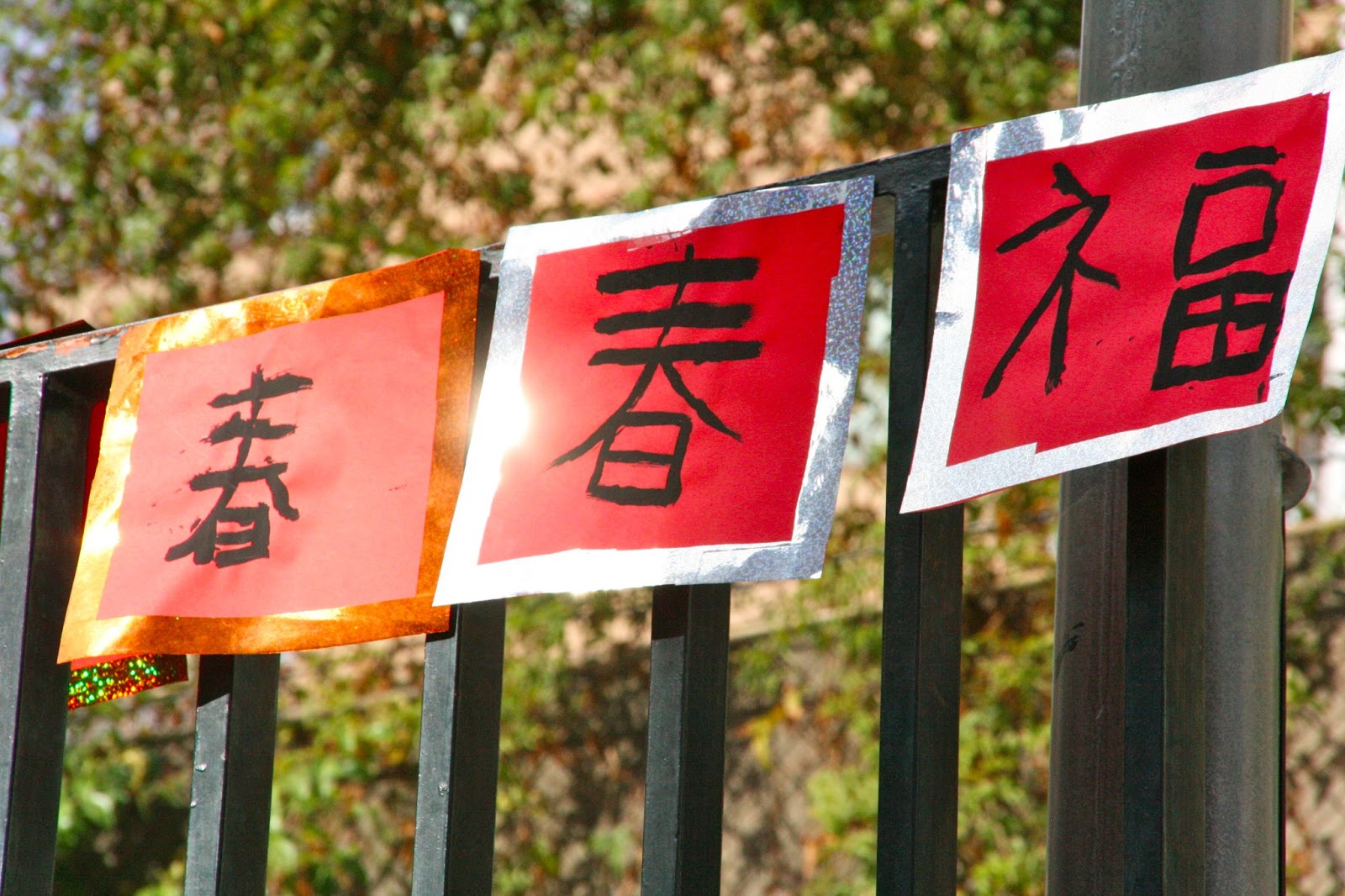
The teachers led various art projects, such as making paper lanterns, Chinese opera masks, dragon puppets, Spring paper cuts,  writing Chinese calligraphy, learning about the Chinese Zodiac, and making ribbon sticks for dancing.  The children even learned to sing the song Gong Xi, Gong Xi in Mandarin.  They danced with their sticks at the same time.


They also learned to say two phrases, "Xin nian kuai le" and "Gong xi fa cai" in order to receive a red envelope with a chocolate euro coin in it from the headmaster.


video of kids enjoying themselves.


The older students created a 7 meter long dragon and paraded around the patio with it.


I felt very happy to be able to share a bit of my cultural knowledge with the students, who were very attentive and sweet.  Their enthusiasm was so heartwarming.  In addition, a lot of parents were very appreciative, and it was a nice way to "break the ice" and feel more a part of the school community.


Monday, February 4, 2013

A Catalan Christmas

Barcelona likes to dress up, and during the holidays the commercial streets all over the city are full of lights.  Each street has a different design, and they can be quite elaborate.


The Catalan equivalent of "Happy Holidays" is Bones Festes (think Buenas Fiestas), which when written in script can look an awful lot like Bones Testes, which made Mark giggle more than once.  Imagine gigantic lighted signs everywhere reminding you to think of your private parts.


An ice-skating rink was put up in Plaza Cataluña, so naturally we had to go.  We had a great time skating with friends from school.


At school, the students put together a Christmas craft fair where they brought in items to sell to parents, with the money raised going to a local children's cancer hospital.  Zoe and Trevor used glittery paper to fold origami cranes, and used them to make mobiles and even earrings.  They were a big hit. The school also put together a precious DVD for parents with nicely edited videos of each class singing and dancing a different holiday tune, accompanied by teachers and students on guitar and piano.  Some were in English, some in Spanish, and some in Catalan.


Barcelonans are crazy for their nativity scenes, which are called Belén (in Spanish, like Bethlehem) or pessebre (in Catalan).  There is a large Christmas market, La Fira de Santa Llúcia, in the square outside the cathedral, where one can purchase boughs of fir and holly, Christmas berries, Tiós de Nadal, and a plethora of miniatures, ceramic and plastic.  You'll find shepherds, angels, wise men on camels, Maria, Joseph, baby Jesus, mangers, animals of every kind, washerwomen, water wheels, windmills, barns, moss, and of course, the most iconic of Catalan figures,  the caganer, or the guy with his pants around his ankles squatting in the corner dropping a deuce.   He is often depicted as a Catalan peasant wearing a red stocking cap called a barretina and sometimes with a red and gold 4-striped Catalan scarf, but one can also find caganers of every flavor, including Santa Claus, footballer extraordinaire Lionel Messi, King Carlos, President Obama, etc.  This beloved Catalan tradition of hiding a pooping figure in one's nativity scene dates back to the 1700s and is also practiced in parts of France, Italy, and Portugal.  The Church apparently tolerates this irreverent figure.  I like the down-to-earth sentiment that all humans must make poo, and thus we fertilize the earth and bring humility and realism to the holy scene.  All of our relations received some version of a caganer as their holiday gift this year, so I hope they see the humor in it. :)


If you read Zoe's previous post, you already know about the Tio de Nadal, or the Christmas Uncle, which is a log dressed up in a hat and blanket, which poops out gifts.  During the holidays every night the kids are supposed to feed the Uncle so that he has something to poop out.  Then on Nochebuena, also known as Christmas Eve, they sit on it and hit it with a stick while they sing a special song.  Then they lift up the blanket to reveal their gifts.


The song goes like this:

Poop, Christmas Uncle, almonds and nut brittle!
Because this night was born our Lord
Don't poop out a herring, because it's too salty
Poop out candy, because it's the best!
Poop, Christmas Uncle!

We had the privilege of sharing that special night with some wonderful Catalan friends.  After a delicious feast, and after singing the song and hitting the pooping log uncle, Carles pulled out his guitar and we sang some Christmas songs.  There are Spanish and Catalan versions to many of the standard Christmas Carols we know and love, such as "Jingle Bells", "Silent Night", and "The Little Drummer Boy."  But we also enjoyed hearing some traditional Catalan Christmas songs, such as "Fum, Fum, Fum" and the beautiful "El Noi De La Mare (The Son of the Mother)."  And of course we had to share "Mele Kalikimaka" (Merry Christmas in Hawaiian) with our new friends.  I taught them how to dance to Pearly Shells, and they did great!


We spent two days at Port Aventura, which is a theme park about an hour south near Tarragona.  Eight kids from Zoe's class and their families went together, and we all had a marvelous time.  Zoe declared it, "The best weekend of my life!"  I have to say the Shambala roller coaster, Europe's highest coaster, was absolutely fantastic.  The ride was so smooth, not at all jerky, and it really felt like we were flying.  (See the white one below)


Then we rented a car and drove to the Principality of Andorra, which is a teeny weenie country in the Pyrenees between France and Spain.  There we skied for three days at Granvalira, which is one of the largest skiable terrains in Southern Europe.  There was no new snow, but there was enough for us to have a great time, and we were really pleased with how the kids' technique is improving.  They are now making parallel turns and starting to use their edges.  Or course if the terrain gets too steep it all goes out the window, but that is psychological...

After all of that celebrating, we all got sick, and passed the germs around.  Mark was unable to get out of bed for two days with a high fever, chills and sweats, so he missed New Year's Eve, which the kids and I celebrated at home making a 3D puzzle of the Sagrada Familia, reading "Harry Potter", and playing Carcassone, a great game that we got for Christmas.  At the stroke of midnight, the custom in Spain is to eat 12 grapes, one with each church bell peale.  Zoe hates grapes so she ate raisins instead.  It is more difficult to do than it sounds, in part because they do not have seedless grapes here, so you have to peel them ahead of time and spit out the seeds while you stuff them in your mouth. Once I finally got the sickness, it took me three weeks to regain my energy level, and more than a month to evict the pathogens taking up residence in my sinuses.


Our lucky duckies got the best of both worlds this year-- they received gifts from the Christmas Uncle (Tió de Nadal) on the 24th, Santa Claus (Papa Noel) on the 25th, AND the Three Wise Men (Los Reyes Magos) on January 6th.  Zoe was very excited to get her own MP3 player (my old iphone) and Trev loves his roller coaster marble run with battery-driven conveyor belt.


The big deal here is on the night of the 5th, when the Three Kings arrive by sailing ship at the port of Barcelona and are met by the mayor of the city.  We braved the crowds to catch a glimpse of the bearded and long-haired Gaspar, the turbaned and swarthy Balthasar, and the wise old Melchior, accompanied by sizeable retinues decked out in glittering robes.  There was an elaborate parade (of course, Barcelona loves parades!) and the streets were packed to the hilt with people being pelted by candies from dancers on elaborate floats.  Like they do in New Orleans, you are supposed to eat a ring-shaped cake in which is hidden a toy.  Whoever finds it is the king for the day, and buys the next year's cake.  One puts their shoes outside that night, and on the morning of the 6th you find the presents that the Kings have left inside of your shoes.


Happy 2013!!!